Why QR Code Coupons Work
Traditional paper coupons require customers to remember to bring them, and digital coupons buried in email newsletters require customers to find them. A QR code printed on packaging, a shelf-talker, a poster, or a receipt is the opposite: it's right there, at the moment when the customer is already engaged with your product or brand.
The mechanics are simple. The QR code encodes a URL that leads to an offer landing page. The customer scans, lands on the page, and either receives a promo code to enter at checkout, taps a button that auto-applies the discount, or shows the screen to a cashier in-store. No searching. No typing. No friction between impulse and redemption.
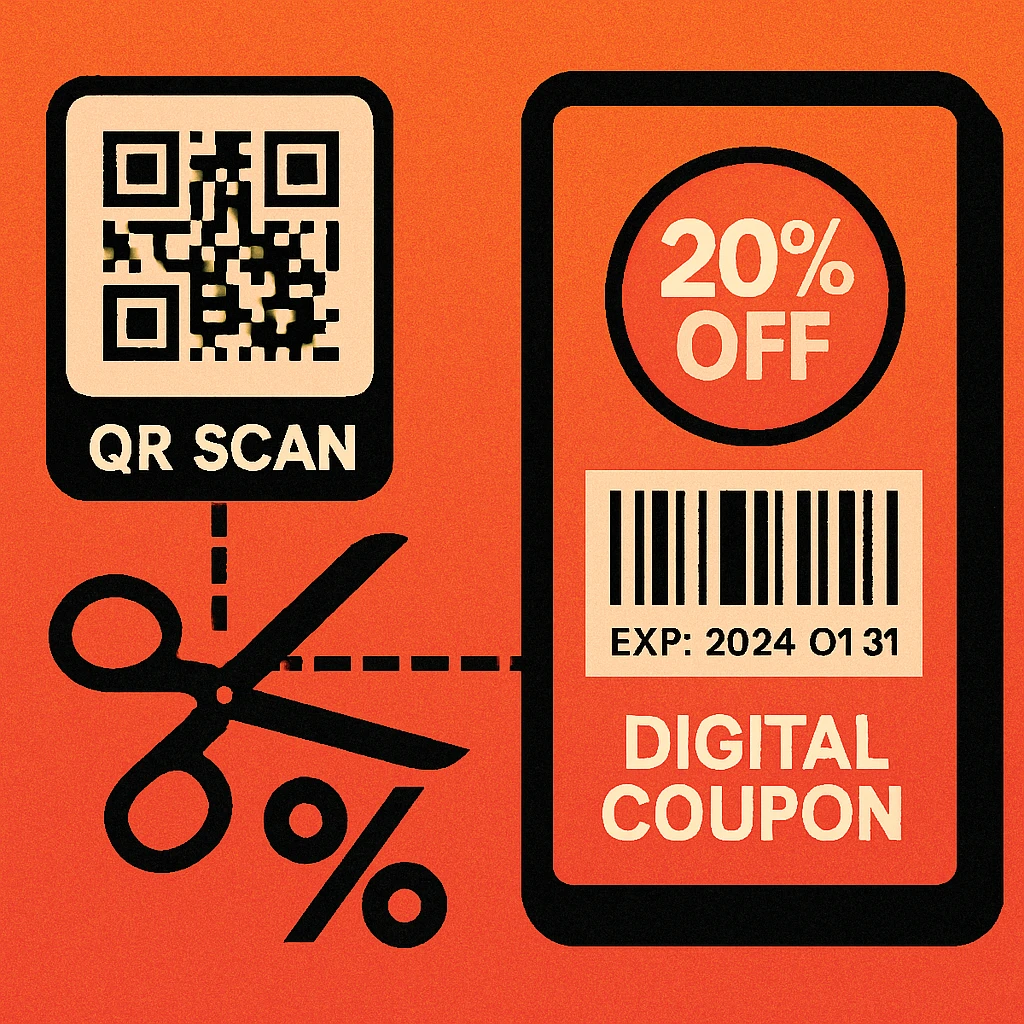
For a broader view of how coupons fit into a full promotional strategy, see our pillar guide on QR code marketing strategy. This article focuses on the practical mechanics: coupon types, campaign architecture, tracking, and urgency tactics.
Unlike static printed coupons, QR codes linked to dynamic URLs can be updated after deployment. If an offer changes, you change the destination URL — the printed code stays exactly as it is. This makes QR coupons ideal for campaigns where you need flexibility after the print run.
Coupon Types That Work With QR Codes
Not every discount type translates equally well to QR-driven delivery. The following are the most effective formats for QR coupon campaigns, ranked broadly by conversion rate in consumer-facing contexts.
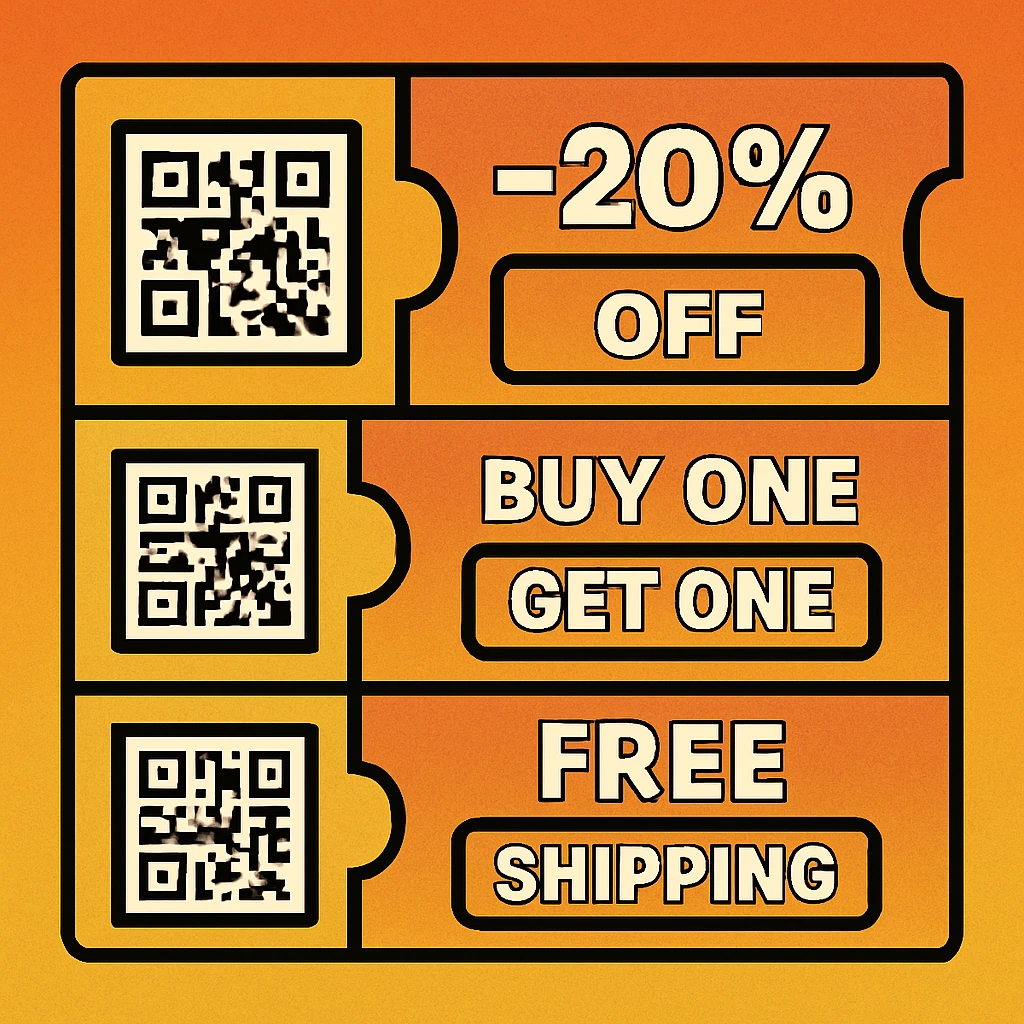
| Coupon Type | Mechanism | Best Use Case | Perceived Value |
|---|---|---|---|
| % Off | Percentage discount on order or item | Broad campaigns, first-time customers | High |
| BOGO | Buy one, get one free or discounted | Loyalty, high-volume products | Very high |
| Free Shipping | Waives delivery cost at checkout | E-commerce, cart abandonment | High |
| Fixed Amount Off | Flat discount (e.g. £5 off £30+) | Basket-size uplift campaigns | Medium |
| Free Gift | Free item added at checkout | Product sampling, new launches | Very high |
| Loyalty Points | Bonus points credited to account | Loyalty programme activation | Medium |
Percentage-Off Discounts
A percentage off is the most universally understood discount format. "20% off your next order" communicates clearly regardless of basket size, currency, or product category. For QR campaigns, a percentage-off code works well when the QR code appears on packaging, receipts, or printed advertising because the customer's basket is not yet defined. The flexibility of a percentage deal means the discount always feels proportionate to what they buy.
BOGO (Buy One Get One)
BOGO offers are highly effective for QR campaigns placed inside or on packaging, because the customer has already committed to one purchase. A QR code on a product that unlocks a "buy a second at half price" offer on a complementary item drives both repeat purchase and basket expansion. BOGO also works well for loyalty programmes — scan once per visit to earn a free item after a set number of purchases.
Free Shipping Codes
Cart abandonment caused by unexpected shipping costs is one of the largest sources of lost e-commerce revenue. A QR code on a print ad, a packaging insert, or a receipt that delivers a free-shipping code directly reduces this barrier at exactly the right moment. Pair a free-shipping QR code with a minimum basket value to protect margins while increasing average order value.
Campaign Flow: From Scan to Redemption
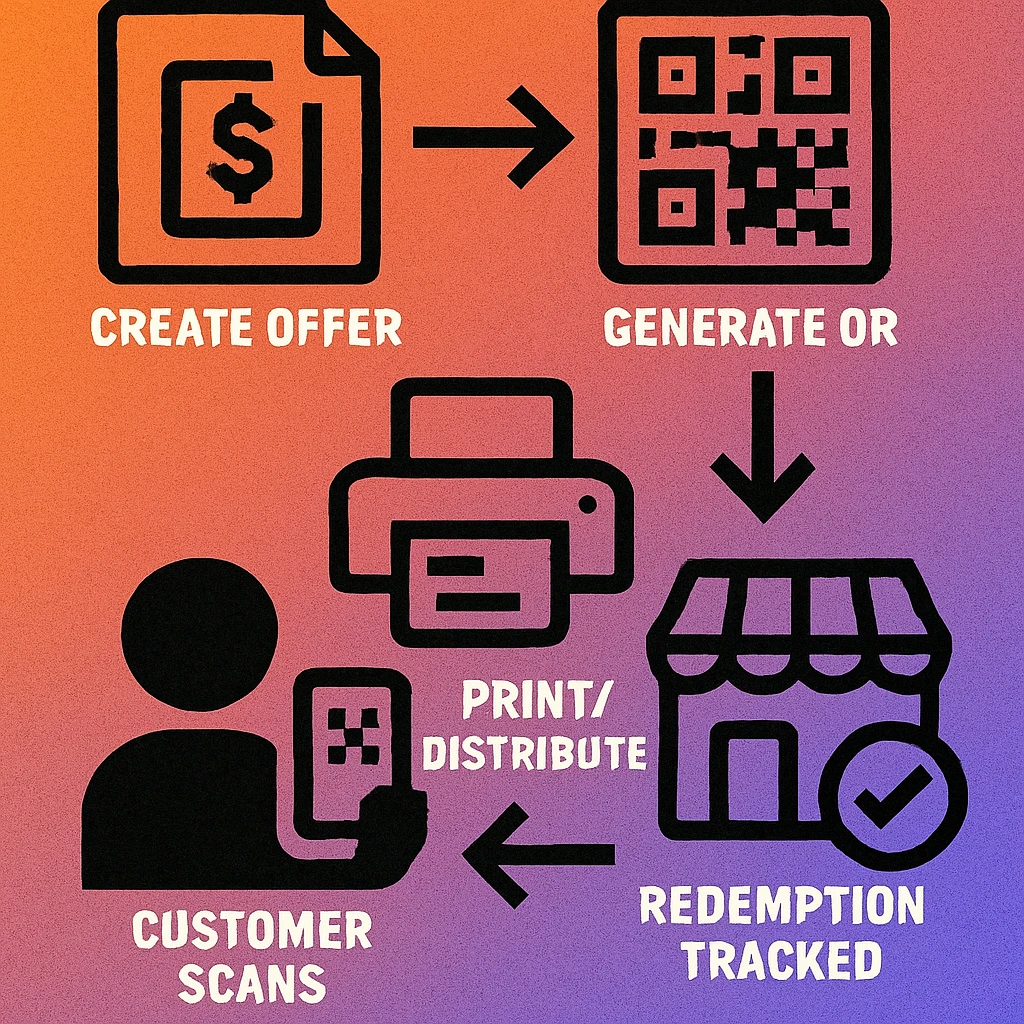
A well-structured QR coupon campaign has five stages. Getting each stage right determines whether a scan converts to a sale.
Five-Stage QR Coupon Campaign Flow
Asset placement. Print or display the QR code where customers are already engaged: product packaging, till receipts, in-store posters, delivery box inserts, or digital touchpoints like email footers and social media posts. Make sure a clear call to action accompanies the code — see our guide on writing effective QR code calls to action for language that converts.
Scan and landing page. The scan delivers the customer to a purpose-built offer page. Keep it focused: a headline that names the offer, a single CTA button (e.g. "Claim 20% Off"), and the promo code displayed prominently. Avoid navigation menus, pop-ups, or anything that adds friction between the customer and the redemption action.
Redemption mechanism. Choose the simplest redemption path for your platform. For e-commerce, auto-apply the code via URL parameter (e.g. ?coupon=SAVE20). For in-store, display a large, clear voucher code or a scannable barcode on screen. For app-based loyalty, deep-link directly to the relevant section of the app.
Confirmation and upsell. After the discount is applied or the offer is claimed, show a confirmation message. This is also the right moment for a secondary offer or a prompt to follow your brand on social media. Keep it light — one action, not three.
Post-campaign analysis. Review scan counts, redemption rates, and revenue attributed to the campaign. Calculate your cost-per-redemption and compare it to other channels. Use the data to refine your next campaign's placement, offer type, and messaging.
QR Code Apps for Mac & Safari
Prefer generating codes without opening a browser tab? These two native Apple apps cover both habits — a full generator on the desktop, and a one-click share button inside Safari.

Redemption Tracking
One of the strongest arguments for QR-delivered coupons over traditional printed ones is the measurement capability. You can track the full funnel: how many people saw the code, how many scanned it, how many landed on the offer page, and how many actually redeemed the offer. For a deep dive into the technical setup, see our article on how to track QR code scans.
UTM Parameters
Append UTM parameters to your coupon landing page URL before generating the QR code. Use utm_source to identify the physical placement (e.g. "packaging", "receipt", "poster"), utm_medium as "qr-code", and utm_campaign for the specific campaign name. Google Analytics or your analytics platform will then segment traffic and conversions by source automatically.
Promo Code Redemption Data
Your e-commerce platform records every use of a promo code — total redemptions, revenue generated, average order value, and new vs. returning customers. Cross-reference this data with your QR scan counts to calculate the scan-to-redemption conversion rate. A high scan rate with a low redemption rate points to a friction problem on the landing page or at checkout. A low scan rate points to placement or CTA issues.
Use a unique promo code per placement if you run the same offer across multiple surfaces (e.g. "PACK20" on packaging and "POSTER20" on in-store signage). Unique codes let you attribute redemptions to specific placements without needing separate QR codes or URLs for each.
Time-Limited Offers and Urgency
Urgency is one of the most reliable conversion levers in promotional marketing. A QR coupon with a deadline outperforms the same offer without one, because inertia is the default state for most customers. Without a reason to act now, they assume the offer will still be there later — and later never comes.
Create Your Coupon QR Code for Free
Generate, customise, and download your campaign QR code in seconds — no account needed. Available on the web and as a Mac app.
Print the Expiry Date on the Asset
The most effective urgency tactic is also the simplest: print "Offer ends [date]" directly on the physical or digital asset next to the QR code. This works because the customer sees the deadline before they even scan, pre-framing the decision as time-sensitive. Make the date prominent — at least as large as the call-to-action text.
Countdown Timers on the Landing Page
If your landing page platform supports it, add a countdown timer that shows the hours and minutes remaining until the offer expires. Countdown timers increase perceived scarcity and urgency without requiring any additional copy. They are especially effective for flash sales and single-day promotions.
Dynamic QR Codes for Offer Expiry
With a dynamic QR code, you control the destination URL from a dashboard. When a time-limited offer expires, redirect the QR code to an "offer expired" page or to a new active promotion. This prevents customer frustration from scanning a code and finding an active offer page for a promotion that has already ended — a common problem with static QR coupon campaigns.
Scarcity-Based Messaging
Limit-based offers ("First 500 customers only") add a second type of urgency: scarcity rather than time. Use your promo code platform to set a maximum redemption count, then message that limit clearly on the asset and landing page. When the limit is reached, the code becomes inactive and the landing page should explain this clearly and offer an alternative action.
Before launching: confirm the QR code scans correctly on iOS and Android, verify the landing page loads in under 2 seconds on mobile, check the promo code applies correctly at checkout, set the expiry date on your platform, and test the post-expiry redirect if using a dynamic code.
Frequently Asked Questions
A QR code coupon encodes a URL that points to a landing page containing the discount offer — a percentage off, a BOGO deal, or a free-shipping code. When a customer scans the code with their smartphone, they are taken directly to the offer page where they can redeem it at checkout, claim a voucher, or add a promo code automatically. Dynamic QR codes allow you to update the destination URL after printing, so you can reuse the same printed asset for different campaigns.
Yes. You can track scan counts using UTM parameters on the destination URL and Google Analytics, or by using a dynamic QR code service that logs scan data. For coupon redemption specifically, your e-commerce platform or POS system records how many times a promo code is used, giving you a conversion rate from scan to redemption. Combining both data sources tells you the full funnel: impressions on the printed asset, scans of the QR code, visits to the offer page, and actual redemptions.
Percentage-off discounts (e.g. 20% off) are the most universally effective because the value is immediately clear regardless of basket size. BOGO offers work well for high-volume products and loyalty campaigns. Free shipping codes are particularly effective for online stores where shipping cost is a known checkout barrier. The best type depends on your margins, your audience, and what action you want to drive — match the offer to the placement and the customer moment.
Print a clear expiry date on the physical or digital asset next to the QR code (e.g. "Offer ends 30 April"). On the landing page, add a countdown timer if your platform supports it. Use dynamic QR codes so you can disable the offer or redirect to an "offer expired" page after the deadline — this prevents customer frustration and maintains trust. Scarcity messaging ("Only 200 codes available") also boosts conversion rates when used honestly.
Yes. In-store QR coupon redemption works well when the cashier can see the customer's screen at checkout. The QR code links to a page that displays a barcode, a promo code to type at the till, or an auto-applied discount. For high-volume retail, integrate QR-triggered promo codes directly with your POS system to reduce friction and prevent cashier error.