Why QR Code Marketing Matters in 2026
QR codes have completed a remarkable transformation. What began as a supply-chain tracking tool in Japanese auto manufacturing is now one of the most effective bridges between physical and digital marketing. In 2026, smartphone penetration exceeds 85% globally, every modern phone camera can read a QR code natively, and consumers have been trained by contactless menus, mobile payments, and product authentication to scan without hesitation.
The result is a marketing channel that is always available, zero-friction, and measurable. Unlike a URL printed on a billboard or a hashtag on a poster, a QR code requires no typing, no remembering, and no searching. The user points their camera, taps once, and arrives at your chosen destination. That directness makes QR codes uniquely powerful for bridging the gap between offline impressions and online conversions.
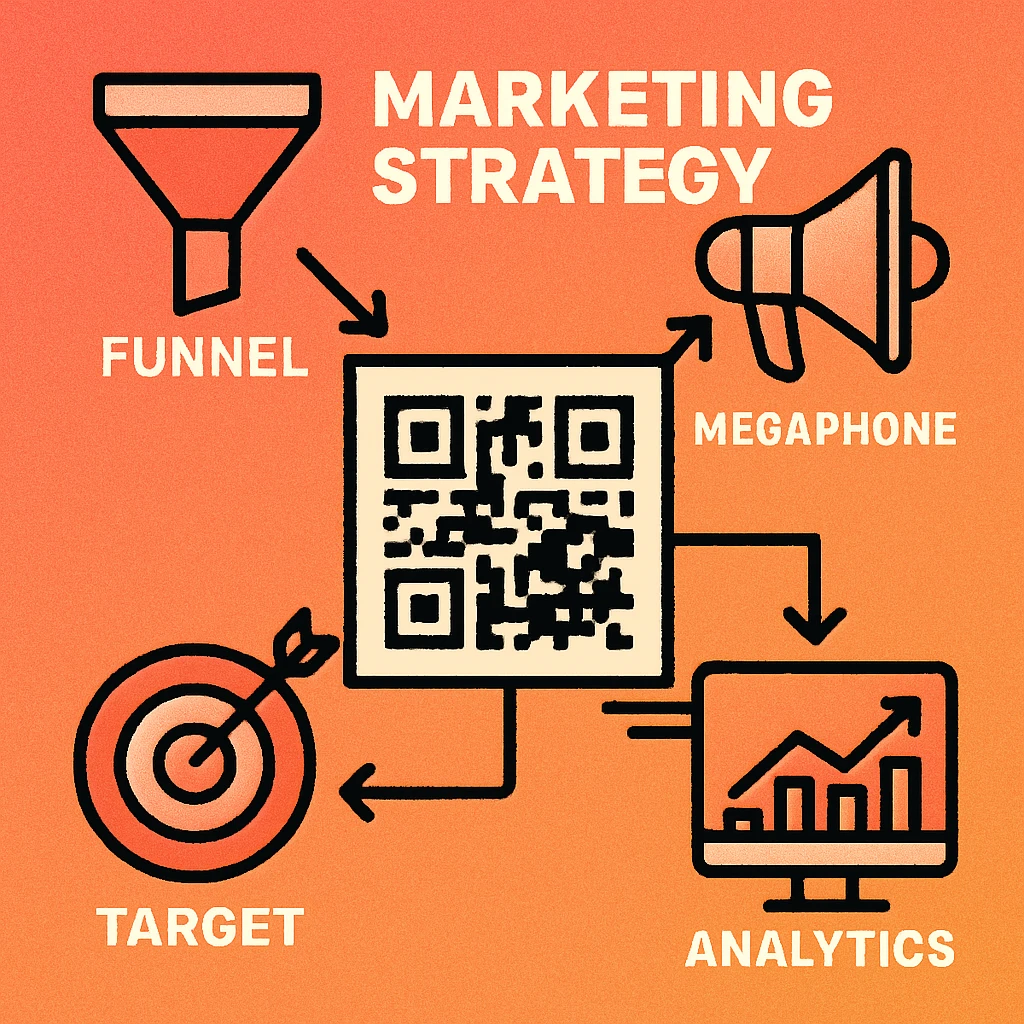
But having a powerful channel is not the same as having a strategy. Too many businesses slap a QR code on a flyer that links to their homepage and call it marketing. That approach wastes the channel's potential. A genuine QR code marketing strategy means integrating QR codes into your marketing funnel deliberately, choosing the right channels, planning campaigns with clear objectives, and measuring results with the same rigour you apply to paid ads or email marketing.
This guide covers every element of that strategy. Whether you are running your first QR campaign or optimising an existing programme, the frameworks, techniques, and best practices below will help you get more scans, better attribution, and higher ROI from every code you deploy.
A QR code is not a marketing strategy. It is a delivery mechanism for a marketing strategy. The code itself is just a link — what matters is where it leads, who scans it, and what they do next. Every decision in this guide flows from that principle.
Integrating QR Codes into the Marketing Funnel
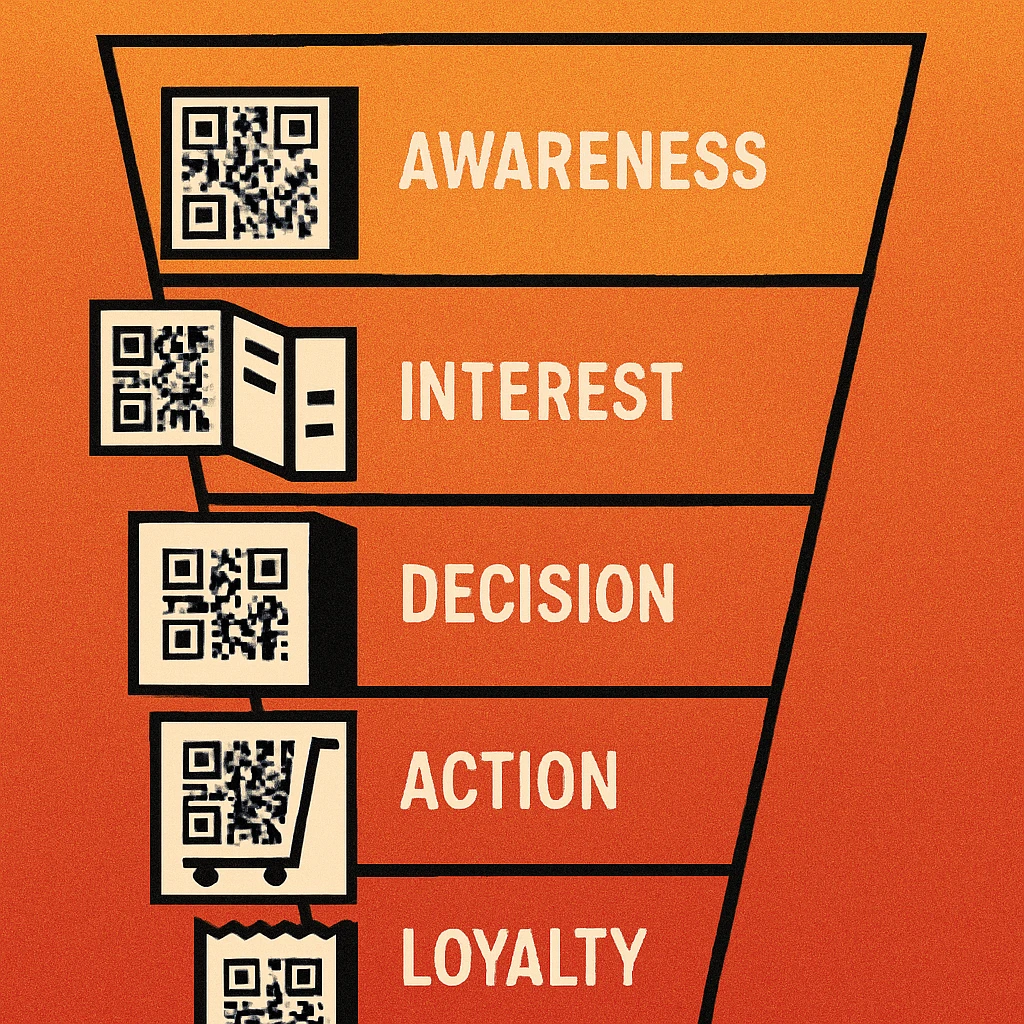
The classic marketing funnel — awareness, interest, decision, action, loyalty — provides a natural framework for QR code deployment. Each stage has different objectives, audiences, and content needs, and QR codes can serve all of them when the destination is matched to the stage.
Awareness Stage
At the top of the funnel, your goal is reach and recognition. QR codes on billboards, transit ads, print advertisements, and event banners drive first-touch traffic. The destination should be a landing page, a video introduction, or an interactive experience — not your homepage. Keep the content short, visually striking, and mobile-optimised. Pair the QR code with a strong call-to-action like "Scan to see it in action" or "Scan for your free guide." For outdoor placements, sizing matters enormously — see our guide on QR codes in print advertising for placement and sizing rules.
Interest Stage
Once someone knows your brand exists, QR codes help deepen engagement. Place them on product packaging to link to detailed specs, how-to videos, or comparison pages. Use them in direct mail campaigns to drive recipients to personalised landing pages. At trade shows and events, QR codes on booth displays can link to downloadable resources, demo scheduling, or product catalogues. The key is providing value that rewards the scan — information the user genuinely wants.
Decision Stage
When prospects are evaluating options, QR codes deliver the nudge that tips the scale. Link to customer testimonials, case studies, free trial sign-ups, or limited-time discount codes. In retail environments, shelf-edge QR codes can link to comparison tools, ingredient details, or user reviews. On proposals and sales decks, a QR code can link to an interactive ROI calculator or a personalised demo recording. The destination content should address objections and build confidence.
Action Stage
At the conversion point, QR codes reduce friction. Link directly to checkout pages, appointment booking forms, registration pages, or app download screens. Restaurant QR codes that link to online ordering are a textbook example — the scan replaces a multi-step process (find website, navigate to menu, select location) with a single tap. The fewer steps between scan and conversion, the higher your completion rate. For digital channels, consider linking to social media profiles where users can follow, share, or engage immediately.
Loyalty Stage
Post-purchase, QR codes on packaging, receipts, and thank-you cards keep customers engaged. Link to loyalty programme enrolment, review submission pages, referral reward programmes, or exclusive content for existing customers. Subscription brands use on-package QR codes to link to reorder pages with pre-filled cart data. This stage is where lead generation meets retention — every repeat interaction builds lifetime value.
Channel Strategy: Where to Deploy QR Codes
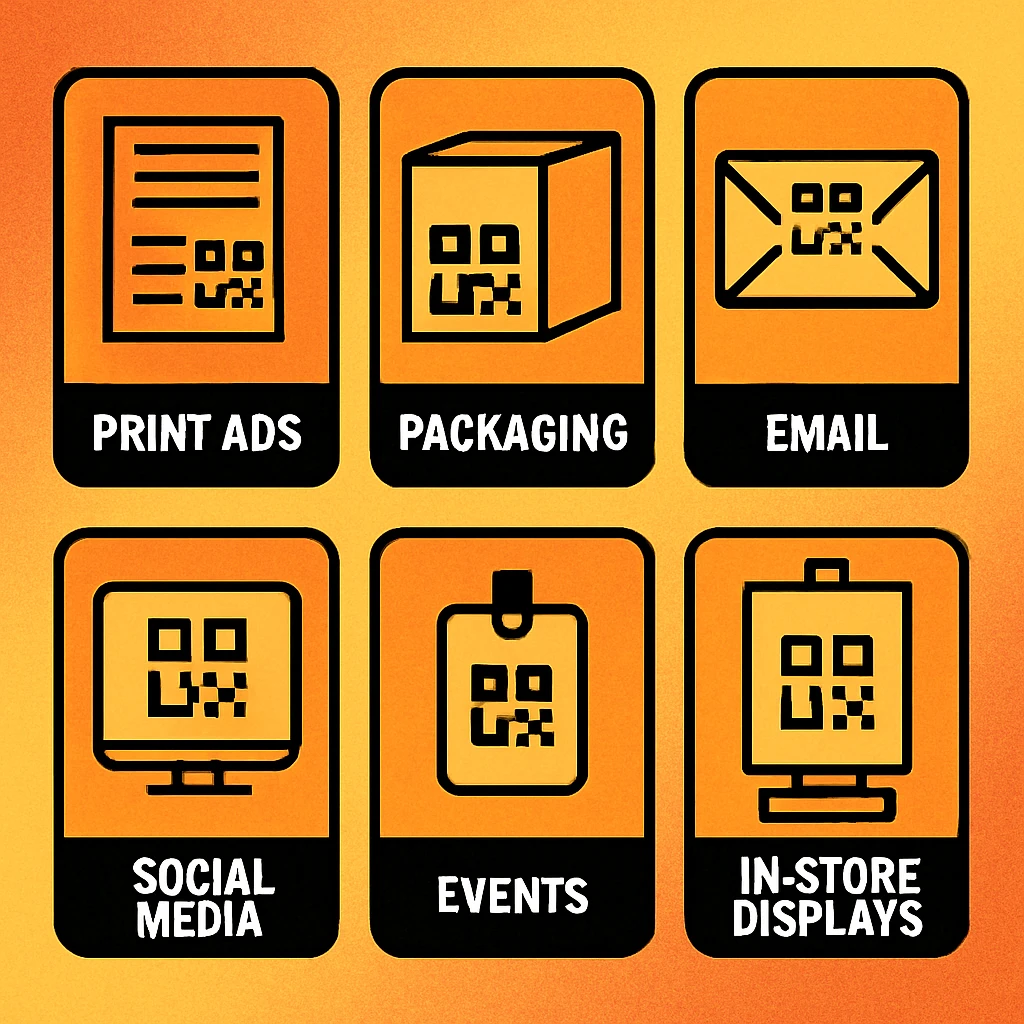
The effectiveness of a QR code depends as much on where it appears as on what it links to. Each channel has different scanning conditions, audience mindsets, and design constraints. Here is a strategic breakdown of the five primary channels for QR code marketing.
| Channel | Typical Placements | Scan Context | Best Destination | Key Challenge |
|---|---|---|---|---|
| Magazines, newspapers, flyers, brochures, direct mail | Stationary, close range, good lighting | Landing page, offer, download | Code size and placement | |
| Packaging | Product boxes, labels, inserts, bags | Post-purchase, indoor, high intent | Setup guide, loyalty, reorder | Surface curvature and finish |
| Digital | Email signatures, presentations, social posts, TV | Screen-to-phone, second screen | App download, profile, event | Screen reflections, timing |
| Events | Booth graphics, badges, programmes, signage | Crowded, variable lighting, brief attention | Contact exchange, schedule, demo | Scan distance, crowd flow |
| In-Store | Shelf tags, window displays, table tents, receipts | Standing, indoor, decision mode | Reviews, comparison, coupon | Competing visual noise |
Print Advertising
Print remains one of the highest-performing channels for QR codes because the audience is already holding the medium and has time to scan. Magazine readers, brochure recipients, and direct mail audiences are in a lean-back mode that favours engagement. The key is placement: position the QR code in the lower-right quadrant of the page with at least 2 cm of clear space around it, and pair it with a clear call-to-action that tells the reader exactly what they will get. Our dedicated guide on QR codes in print advertising covers sizing formulas, colour requirements, and layout best practices for every print format.
Product Packaging
Packaging QR codes reach customers at the moment of highest engagement — when they are holding your product. This is the ideal moment for onboarding (setup guides, how-to videos), loyalty (programme enrolment, reward collection), and advocacy (review requests, referral codes). The challenges are physical: curved surfaces require larger codes, glossy finishes can cause glare, and small packages limit available space. See our article on QR codes for product packaging for material-specific recommendations and testing protocols.
Digital Surfaces
QR codes on screens work in a second-screen context: the user sees the code on a TV, monitor, or projected slide and scans it with their phone. This creates a frictionless path from passive viewing to active engagement. Use QR codes in webinar presentations, conference talks, YouTube end screens, and email signatures. For social media marketing, QR codes in story posts and reels can bridge platforms. Digital QR codes also benefit from real-time scan tracking since you can update the destination instantly.
Events and Trade Shows
Events demand QR codes that work fast in imperfect conditions. Attendees are moving, lighting varies, and attention spans are short. Use large, high-contrast codes on booth backdrops and banners. Place smaller codes on badge holders and programme pages for at-seat scanning. Link to contact exchange forms (replacing paper business cards), session schedules, or post-event surveys. Our guide on QR codes for trade shows and events provides detailed sizing, placement, and workflow recommendations for conference environments.
Retail and In-Store
In-store QR codes reach shoppers at the point of decision. Shelf-edge codes can link to product comparisons, ingredient details, nutritional information, or customer reviews. Window displays can link to online-exclusive promotions. Table tents in restaurants link to menus, ordering, or loyalty sign-ups. Receipt-printed QR codes drive post-purchase engagement. The challenge is standing out in a visually busy retail environment. For proven in-store strategies, see our article on QR codes for retail and in-store marketing.
Launch Your QR Marketing Campaign
Create branded, trackable QR codes in seconds. Free generator with UTM-ready URLs and instant PNG/SVG downloads.
Campaign Planning Framework
A QR code campaign is not a standalone tactic — it is a component of a broader marketing initiative. Every campaign should be planned with the same rigour as an email sequence or paid ad flight. The following framework ensures your QR campaigns are structured for results.
Seven-Step QR Campaign Planning Process
Define the objective. What do you want the scan to achieve? Lead capture, product education, coupon redemption, app install, event registration? One QR code, one objective. Never link to your homepage and hope for the best.
Identify the audience segment. Who will encounter this QR code? Existing customers on packaging? Cold prospects at a trade show? Retail shoppers comparing products? The audience determines the destination content, the value proposition, and the call-to-action language.
Choose the channel and placement. Where will the QR code physically appear? This determines sizing, design constraints, and scanning conditions. A billboard QR code has different requirements than a business card QR code. For a full breakdown of business use cases, see our comprehensive catalogue.
Build the destination. Create a mobile-optimised landing page that fulfils the promise of your call-to-action. The page should load in under three seconds, display correctly on all phone sizes, and have a single clear action. Avoid linking to desktop-oriented pages or generic homepages.
Configure UTM parameters. Tag the destination URL with UTM parameters so you can track campaign performance in your analytics platform. Use consistent naming conventions across all campaigns. See the UTM tracking section below for parameter structure.
Generate and test the QR code. Create the code with appropriate error correction, branding, and sizing. Test on at least three devices (iPhone, Android, dedicated scanner app) in conditions that simulate the deployment environment. Use scan tracking to verify the analytics pipeline before launch.
Deploy, measure, and iterate. Launch the campaign, monitor scan rates and conversion data daily for the first week, then weekly thereafter. Compare performance against your objective. Run A/B tests on underperforming placements. Update dynamic QR code destinations based on results.
Use dynamic QR codes for all marketing campaigns. Dynamic codes let you change the destination URL after printing, so you can fix errors, update offers, or redirect traffic without reprinting materials. They also enable scan analytics that static codes cannot provide. For a deep dive into campaign tracking, see our guide on how to track QR code scans.
QR Code Apps for Mac & Safari
Prefer generating codes without opening a browser tab? These two native Apple apps cover both habits — a full generator on the desktop, and a one-click share button inside Safari.
UTM Tracking and Attribution
Without proper tracking, QR code marketing is a black box. You know you printed codes, and you know you got website traffic, but you cannot connect the two. UTM parameters solve this by embedding campaign metadata directly into the destination URL, allowing your analytics platform to attribute every scan to a specific campaign, channel, and placement.
UTM Parameter Structure for QR Campaigns
Use the following parameter structure consistently across all QR code campaigns:
| Parameter | Purpose | Example Value |
|---|---|---|
| utm_source | Identifies the physical or digital placement | product_box, trade_show_booth, magazine_ad |
| utm_medium | Identifies the channel type | qr_code |
| utm_campaign | Identifies the specific campaign | spring_2026_launch, loyalty_programme |
| utm_content | Differentiates multiple codes in the same campaign | shelf_talker_a, receipt_footer, banner_left |
| utm_term | Optional: tracks specific offer or variant | 20pct_discount, free_shipping |
A complete tagged URL looks like this:
https://example.com/spring-offer?utm_source=product_box&utm_medium=qr_code&utm_campaign=spring_2026_launch&utm_content=inner_flap
Consistency is critical. Establish a naming convention document that every team member follows. Use lowercase, underscores instead of spaces, and descriptive but concise values. Inconsistent UTM tagging creates fragmented data that is difficult to analyse and impossible to compare across campaigns.
Attribution Models
QR code scans are typically a first-touch or assist interaction in a multi-touch customer journey. A user might scan a QR code on packaging, browse your site, leave, receive a retargeting ad, and then convert. In a last-click attribution model, the retargeting ad gets credit. In a first-click or position-based model, the QR code scan is properly recognised as the initiating touchpoint.
For accurate QR code attribution, consider using a position-based or time-decay model in your analytics platform. If you are using Google Analytics 4, the data-driven attribution model handles this automatically for campaigns with sufficient volume. For deeper analysis of scan tracking methods, our guide on how to track QR code scans walks through platform-specific setup.
A/B Testing QR Code Campaigns
A/B testing is how you move from assumptions to evidence. In QR code marketing, you can test far more variables than most marketers realise — and the feedback cycle is fast because scans are instantaneous and measurable.
What to Test
- Call-to-action text: "Scan for 20% off" vs. "Scan to see the collection" vs. "Scan for your free guide"
- QR code design: Branded with logo vs. plain black-and-white. Dot style vs. square style. See our guide on custom QR code design for how design affects scan rates.
- Placement position: Top-right vs. bottom-centre on a flyer. Above the fold vs. back cover of a brochure.
- QR code size: 3 cm vs. 5 cm on the same material type.
- Landing page content: Video vs. text. Short form vs. long form. Single CTA vs. multiple options.
- Offer type: Percentage discount vs. free shipping vs. free gift with purchase.
- Frame and CTA overlay: QR code with "Scan Me" frame vs. no frame. Different frame colours and messages.
How to Structure a Test
Create two versions of your QR code with different UTM content parameters (e.g., utm_content=variant_a and utm_content=variant_b). Deploy them to comparable audiences or locations. For print campaigns, this might mean version A goes to one half of a mailing list and version B to the other. For in-store tests, alternate placements between comparable store locations.
Run the test for a minimum of two weeks or until you have at least 100 scans per variant — whichever takes longer. Compare scan rates (impressions to scans), click-through rates (scans to page views), and conversion rates (page views to desired actions). The winning variant becomes your control for the next test.
The single most impactful variable in QR code marketing is almost always the call-to-action, not the code design. A clear, benefit-driven CTA ("Scan to save 25% today") will outperform a beautifully designed QR code with a vague prompt ("Scan here") every time. Test your CTA first.
Designing QR Codes for Conversion
Marketing QR codes are not just functional — they need to be persuasive. The visual design of the code and its surrounding context directly impact scan rates. There are three layers to QR code design in a marketing context.
The Code Itself
Brand-aligned QR codes scan more often than generic ones. Use your brand colours (maintaining sufficient contrast), add your logo to the centre, and choose a module style that matches your brand aesthetic. Our pillar guide on custom QR code design covers these techniques in detail, and our colour combinations guide provides safe palette options.
The Frame and CTA
A QR code without a call-to-action is an invitation that nobody accepts. Surround the code with a frame that includes a clear action phrase: "Scan to order," "Scan for your discount," or "Scan to learn more." The frame should be visually distinct from the surrounding design so the QR code reads as an interactive element, not a decorative one. See our article on QR code frame design for frame styles that drive action.
The Surrounding Context
The real estate around the QR code matters. Position the code near supporting copy that explains the value of scanning. Avoid burying it in a corner or placing it on a cluttered background. Give it breathing room — at least four module widths of quiet zone, plus visual whitespace beyond that. Avoid the most common design mistakes that kill scan rates: low contrast, tiny sizes, and missing CTAs.
Measuring QR Code Marketing ROI
QR code ROI measurement follows the same logic as any other marketing channel: compare the cost of deployment against the revenue (or value) generated by the resulting conversions. The key metrics form a funnel of their own.
Core Metrics
- Impressions: How many people saw the QR code. For print, this is circulation or distribution volume. For in-store, it is foot traffic past the placement.
- Scan rate: The percentage of impressions that resulted in scans. Industry benchmarks range from 1–5% for print advertising to 8–15% for product packaging.
- Engagement rate: The percentage of scanners who interacted with the landing page beyond the initial view (scrolled, clicked, played a video).
- Conversion rate: The percentage of engaged users who completed the desired action (purchase, sign-up, download, form submission).
- Revenue per scan: Total revenue attributed to the campaign divided by total scans. This is your headline efficiency metric.
For campaigns focused on lead generation, replace revenue metrics with lead quality scores and downstream conversion rates. The measurement framework stays the same — only the final metric changes.
In 2026, high-performing QR code marketing campaigns achieve 3–8% scan rates on print materials, 10–20% scan rates on product packaging, and 15–30% conversion rates on well-designed landing pages. If your numbers are below these ranges, focus on improving your CTA, placement visibility, and landing page load speed before changing the QR code design.
Advanced QR Marketing Tactics for 2026
Once the fundamentals are in place, these advanced tactics can significantly amplify your QR code marketing results.
Location-Based Dynamic Routing
Dynamic QR codes can detect the scanner's location and route them to location-specific content. A national retail chain can print one QR code on all packaging but serve a landing page customised to the user's nearest store, complete with local inventory, store hours, and directions. This combines the efficiency of mass printing with the personalisation of local marketing.
Sequential Engagement Campaigns
Use QR codes at multiple touchpoints in the customer journey, each building on the previous interaction. First scan: product discovery video. Second scan (on packaging after purchase): setup tutorial and loyalty sign-up. Third scan (in follow-up email): exclusive content or referral reward. Each scan deepens the relationship and increases lifetime value.
Integration with CRM and Marketing Automation
Connect QR code scan data with your CRM to build richer customer profiles. When a user scans a QR code and submits a form, their scan history, location, and timestamp can feed into automated email sequences, lead scoring models, and segmentation rules. This turns a simple scan into a data-rich touchpoint that informs your entire marketing programme. Learn how to calculate the business impact with our QR code ROI calculator.
Multi-Language and Accessibility
For global campaigns, dynamic QR codes can detect the user's device language and serve content in their preferred language automatically. This eliminates the need for language-specific QR codes on multilingual packaging. Additionally, ensure your landing pages meet WCAG accessibility standards — proper heading structure, alt text, sufficient colour contrast, and keyboard navigation.
Cross-Channel Retargeting
Place a retargeting pixel on your QR code landing page. Users who scan but don't convert can be retargeted with display ads, social media ads, or email sequences. This extends the value of every QR code impression beyond the initial scan. The physical code drives the first touch; digital retargeting closes the loop. For a comprehensive overview of how this fits into broader business strategy, see our guide on QR code business use cases.
Small Business Applications
QR code marketing is not just for enterprise brands. Small businesses can use QR codes on business cards, window signage, receipts, and local flyers to drive reviews, social follows, appointment bookings, and repeat visits. The low cost of QR code generation makes it one of the most accessible marketing channels for businesses of any size. Restaurants, in particular, have embraced QR codes for menus, ordering, and feedback — see our guide on QR codes for restaurants for industry-specific strategies.
Start Building Your QR Strategy Today
Generate branded QR codes with tracking-ready URLs. Free, fast, and no account required.
Frequently Asked Questions
QR codes can serve every stage of the marketing funnel. At the awareness stage, they drive traffic from print ads, billboards, and packaging to landing pages. During the interest and consideration phases, they link to product demos, comparison guides, and testimonials. At the decision stage, they deliver discount codes or limited-time offers. Post-purchase, QR codes on packaging can trigger loyalty programme sign-ups, review requests, and reorder flows.
Use utm_source to identify the physical or digital placement (e.g., ‘product_packaging’, ‘trade_show_booth’), utm_medium as ‘qr_code’, utm_campaign for the campaign name, and optionally utm_content to differentiate between multiple QR codes in the same campaign. This structure lets you attribute scans accurately in Google Analytics or any analytics platform.
Create two or more QR codes that link to different landing pages or use different UTM parameters. Place them in comparable locations or distribute them to similar audience segments. Compare scan rates, click-through rates, and conversion rates over a defined test period. You can test variables like QR code design, call-to-action text, placement position, landing page content, and offer type.
QR codes perform well across print advertising (magazines, newspapers, flyers), product packaging, direct mail, event materials (badges, banners, booth displays), in-store signage (shelf tags, window displays, receipts), and out-of-home advertising (billboards, transit ads, posters). The key is matching the QR code's destination to the context where it will be scanned.
Dynamic QR codes are almost always the better choice for marketing campaigns. They allow you to change the destination URL after printing, track scan analytics in real time, run A/B tests without reprinting, and redirect users based on location or device. Static QR codes are simpler and work offline, but they cannot be updated or tracked once deployed.
The minimum recommended size is 2 cm x 2 cm (about 0.8 inches) for close-range scanning such as business cards and product labels. For posters and signage scanned from a distance, follow the 10:1 rule — the QR code should be at least one-tenth the expected scanning distance. A billboard scanned from 3 metres away needs a QR code at least 30 cm wide.