The Green Case for QR Codes in Marketing
Marketing has a paper problem. Menus, flyers, brochures, product inserts, event programmes, receipts — most are read once and discarded. The global printing industry accounts for roughly 4% of worldwide carbon emissions, and marketing-related print is a significant slice of that total. For businesses seeking genuine sustainability credentials, reducing print volume is one of the most measurable actions available.
QR codes are a practical lever. A single code printed on a durable surface — a table card, a product label, a reusable bag — can replace dozens or hundreds of individual printed items over its lifetime. And when paired with dynamic QR codes that redirect to updated content without requiring a new physical code, the savings multiply dramatically.
This article focuses on four high-impact use cases: digital menus, e-receipts, reusable packaging, and dynamic content updates. For a broader look at deploying QR codes across your marketing mix, see our pillar guide on QR code marketing strategy.
The sustainability gain from a QR code comes not just from replacing paper once, but from replacing the cycle of reprinting. A dynamic QR code printed today can serve updated content for years — eliminating every reprint that would otherwise follow a price change, seasonal update, or regulatory revision.
Digital Menus: The Highest-Volume Paper Replacement
Restaurant menus are among the most-reprinted items in the hospitality industry. Prices change seasonally. Dishes rotate. Suppliers shift. Each update triggers a reprint run across every copy in circulation — often laminated, meaning recycling is difficult or impossible.
A QR code on a table card or a small printed stand sends diners directly to a live digital menu hosted at a stable URL. When the menu changes, only the web page changes — not the physical QR code. The code itself can be printed on durable card or etched into a table surface and remain valid indefinitely. For implementation details, see our full guide on QR codes for restaurant menus.
How Much Paper Does a Digital Menu Save?
Consider a restaurant with 40 tables, four laminated menus per table (160 menus total), reprinted quarterly due to seasonal changes. That is 640 laminated sheets per year, per location. A chain of 50 locations discards 32,000 laminated sheets annually — most of which cannot be recycled. Switching to QR-linked digital menus eliminates this entirely after the first set of table cards is printed.
Print your QR code on thick card stock or have it laser-engraved onto a small acrylic or wooden stand. A durable physical display lasts years and survives the constant handling of a busy dining room without fading or peeling.
E-Receipts and Paperless Point of Sale
Thermal receipt paper is one of the most wasteful material streams in retail. The paper is thin, treated with BPA or BPS chemicals, and almost universally non-recyclable. Globally, tens of billions of receipts are printed each year, the majority of which are thrown away within minutes.
QR codes enable a simple alternative: a code displayed on a point-of-sale screen or printed minimally on a small slip directs customers to a digital receipt hosted at a unique URL. The customer scans, gets a full receipt on their device, and nothing physical is handed over. For businesses that must provide a paper option by law, the QR code on a minimal thermal slip can supplement a shortened receipt, dramatically reducing paper use per transaction.
E-Receipt Benefits Beyond Sustainability
- Digital receipts can carry loyalty offers, upsell links, and review requests — a channel that a paper receipt cannot offer
- Receipts are searchable and retrievable by customers long after the transaction
- Reduced thermal paper purchase costs (thermal rolls represent a measurable operational expense)
- Lower staff handling time for receipt management and returns processing
Reusable Packaging and Smart Product Labels
Product packaging is a major source of print waste, and much of the text printed on packs becomes outdated quickly. Regulatory changes, ingredient updates, allergen declarations, and sustainability certifications all require costly reprinting — or worse, the disposal of perfectly functional packaging stock.
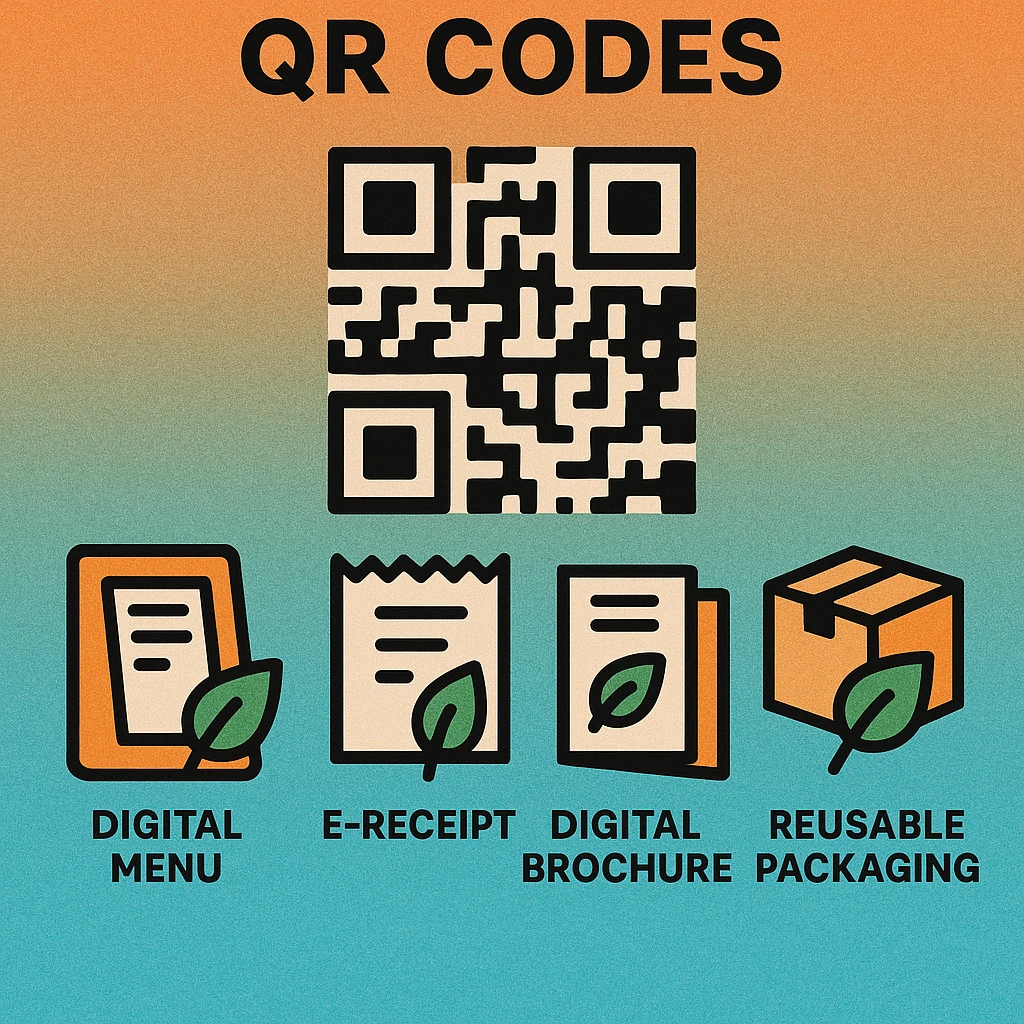
A QR code on the label or pack surface can carry all of the information that changes regularly — nutritional details, extended instructions, promotional content, compliance notices — while the static printed pack carries only the content that genuinely does not change. When regulations or product details update, only the linked web page changes. The packaging itself remains valid and in use. For a deep dive on this approach, see our guide on QR codes for product packaging.
Refillable and Reusable Packaging
QR codes are particularly powerful on refillable or reusable packaging — bottles, containers, and bags that customers return, refill, and reuse across multiple product cycles. A QR code on a refillable bottle can update its linked content every time the bottle is refilled with a different product variant, without replacing the bottle or its label. The code works across every refill cycle, serving fresh content each time.
Dynamic Updates Without Reprinting
The sustainability multiplier of QR codes is the dynamic QR code. Unlike a static code where the destination URL is baked into the code itself, a dynamic code stores a short redirect that can be pointed to any destination at any time. This single feature transforms a printed QR code from a one-time communication tool into a durable, reusable marketing asset.
| Scenario | Static QR Code | Dynamic QR Code |
|---|---|---|
| Price change | Reprint required | Update URL only |
| Seasonal menu swap | Reprint required | Update URL only |
| New promotional offer | Reprint required | Update URL only |
| Regulatory label update | New packaging run | Update landing page |
| Campaign end / redirect | Dead link or reprint | Redirect to new URL |
Every row in that table represents a reprint cycle that is eliminated. For businesses running multiple campaigns across multiple locations and products, the cumulative paper, ink, and energy savings are substantial. Dynamic QR codes are a core pillar of the sustainable marketing toolkit described in our QR code marketing strategy guide.
Generate a Free Dynamic QR Code
Create a QR code that updates without reprinting. Change the destination URL any time — no new code needed.
QR Code Apps for Mac & Safari
Prefer generating codes without opening a browser tab? These two native Apple apps cover both habits — a full generator on the desktop, and a one-click share button inside Safari.


Environmental Savings Metrics
Sustainability claims need to be grounded in measurable reality. The following estimates illustrate the scale of paper reduction achievable by businesses that systematically replace print with QR-linked digital content.
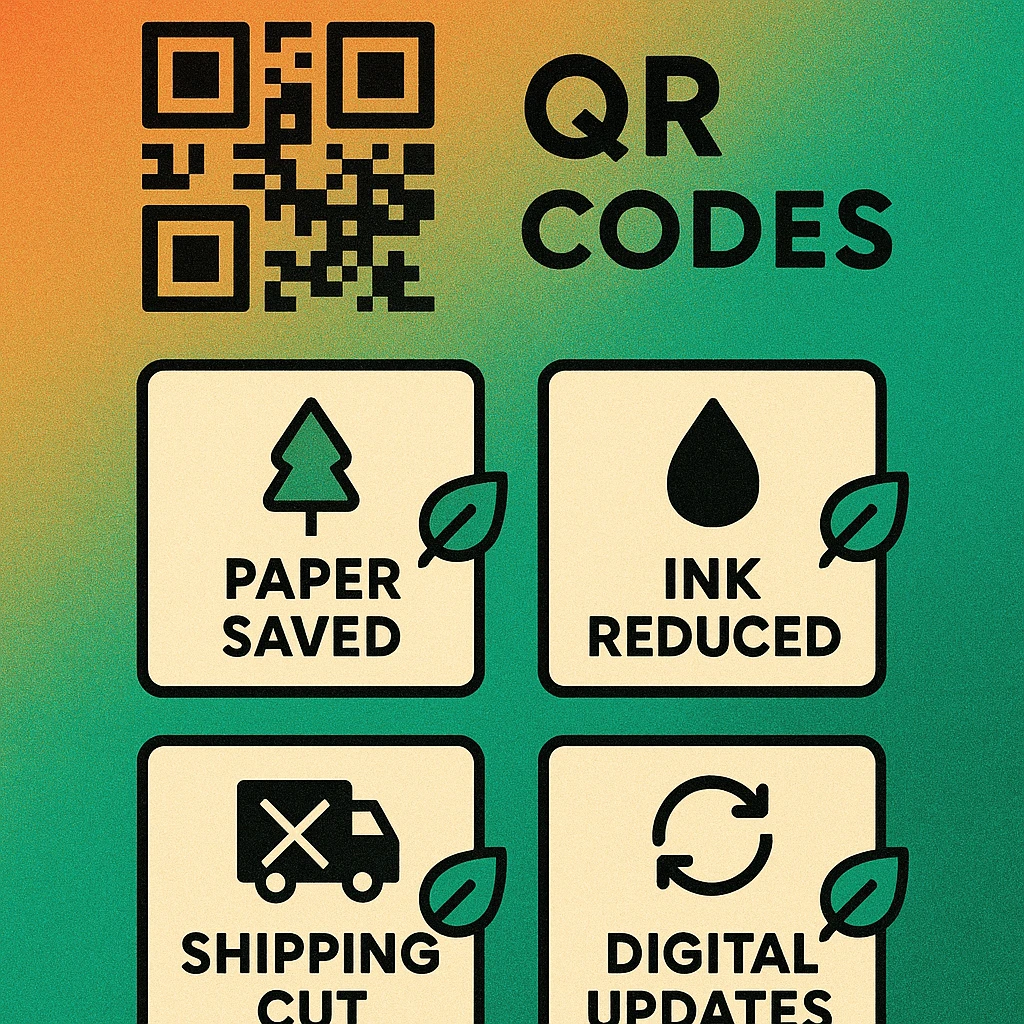
These figures are illustrative, but the direction of travel is consistent: businesses that treat QR codes as a strategic paper-reduction tool — not just a convenient link shortcut — achieve measurable waste reductions that can be quantified, reported in sustainability disclosures, and communicated to environmentally conscious consumers.
If your business tracks environmental KPIs, QR code adoption provides a clean, quantifiable metric: number of reprints avoided, sheets of paper not consumed, or volume of laminated material diverted from landfill. Dynamic QR platforms typically provide scan analytics that let you calculate engagement-per-code — a direct measure of how many individual print items a single code has replaced.
Getting Started: A Practical Rollout
Five Steps to a Paperless QR Marketing Strategy
Audit your highest-volume print materials. List everything your business reprints regularly: menus, price lists, product inserts, flyers, receipts. Rank them by annual volume and frequency of change. These are your highest-impact targets for QR replacement.
Use dynamic QR codes for any content that changes. Generate dynamic codes through our free generator or via a QR platform that supports redirect management. Assign one code per content category — one for your menu, one for your receipt portal, one per product line on packaging.
Print on durable substrates. The environmental benefit of a QR code is maximised when the code itself lasts. Print on thick card, laminate a single master copy, or use materials like brushed metal, acrylic, or wood engraving for table displays and permanent signage.
Host your digital content on mobile-optimised pages. A digital menu or e-receipt that is awkward to read on a phone defeats the purpose. Ensure your linked content is responsive, loads quickly, and is genuinely more useful than the paper it replaces.
Track and report your savings. Use QR analytics to log scan counts and calculate paper items displaced. Report this in your annual sustainability communications, on your website, and to any certification bodies relevant to your sector.
Frequently Asked Questions
QR codes replace printed materials that typically need frequent reprinting. A restaurant with 40 tables that reprints laminated menus every quarter saves hundreds of sheets per year by switching to a QR-linked digital menu. Flyers, brochures, event programmes, and product inserts can all be replaced with a single QR code pointing to a regularly updated web page — with zero reprinting required when content changes.
Yes, significantly so when dynamic QR codes are used. A single dynamic QR code on a durable table card can serve thousands of customers over years, with the menu content updated instantly online. By contrast, laminated paper menus must be reprinted whenever prices, items, or seasonal dishes change. A mid-sized restaurant can save 2,000–5,000 sheets of laminated stock per year by making the switch. The environmental saving is compounded across hundreds or thousands of locations for chains.
A dynamic QR code stores a short redirect URL rather than the destination content directly. This means you can update where the code points — changing menus, promotions, PDFs, or landing pages — without generating or printing a new QR code. From a sustainability standpoint, a single printed dynamic QR code can serve many content cycles throughout its physical lifetime, making it far more efficient than static codes that become outdated and must be replaced.
Yes — this is one of the most powerful sustainability applications of dynamic QR codes on product packaging. Rather than disposing of and reprinting entire packaging runs when nutritional information, instructions, or compliance notices change, a dynamic QR code on the pack can be redirected to an updated product information page immediately. The physical packaging remains valid, cutting both waste and reprinting costs substantially.