Why QR Codes for Loyalty Programs?
Traditional loyalty programs rely on plastic cards, paper punch stamps, or dedicated apps that customers often forget to install. QR codes solve all three problems at once. A customer sees the code at checkout, scans it with the camera already on their phone, and their reward is recorded instantly — no card to carry, no app to download, no staff manually punching paper.
For a broader picture of how QR codes drive marketing outcomes, start with our pillar guide: QR Code Marketing Strategy. Loyalty programs represent one of the highest-ROI applications in that ecosystem, because every scan is a data point and every reward redeemed is evidence of a retained customer.
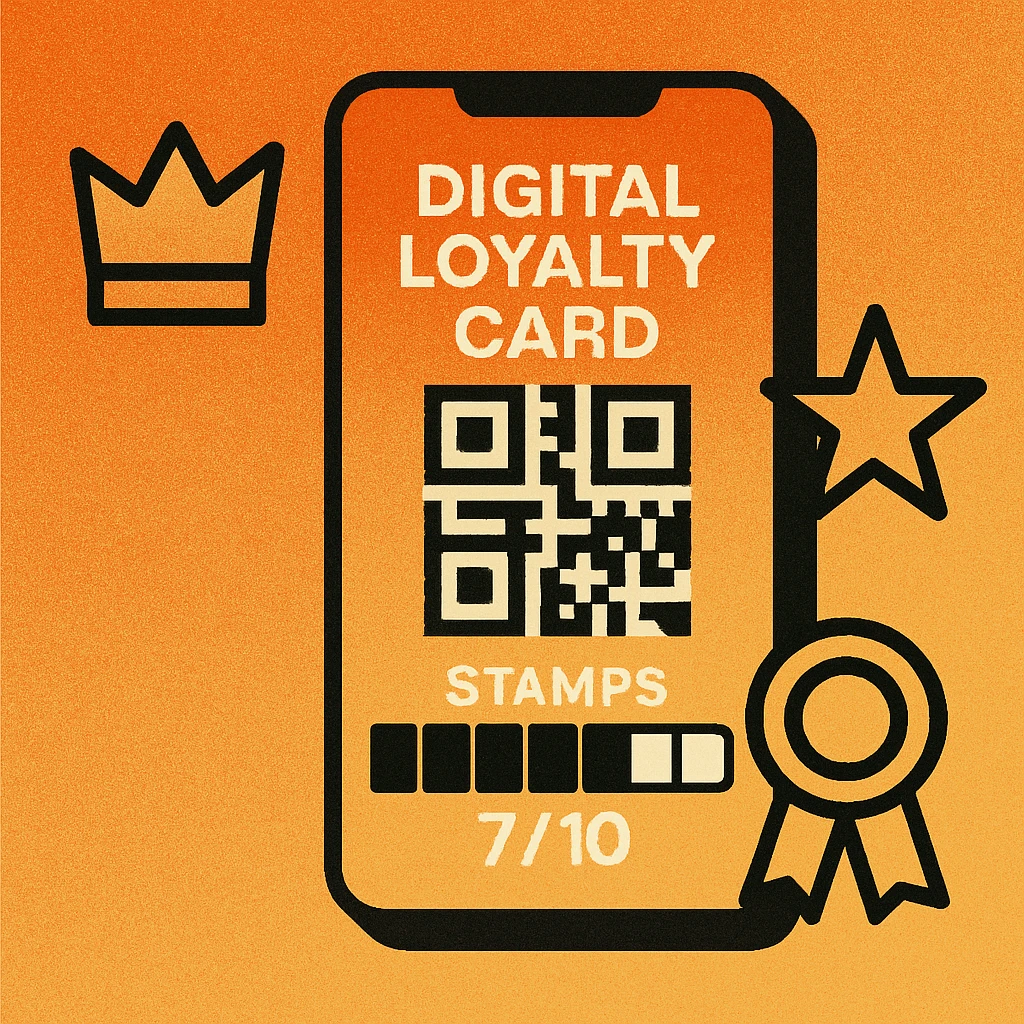
Increasing customer retention by just 5 % can boost profits by 25–95 % (Bain & Company). A QR loyalty program is one of the most cost-effective mechanisms to achieve that retention lift without a large technology budget.
Types of QR Code Loyalty Programs
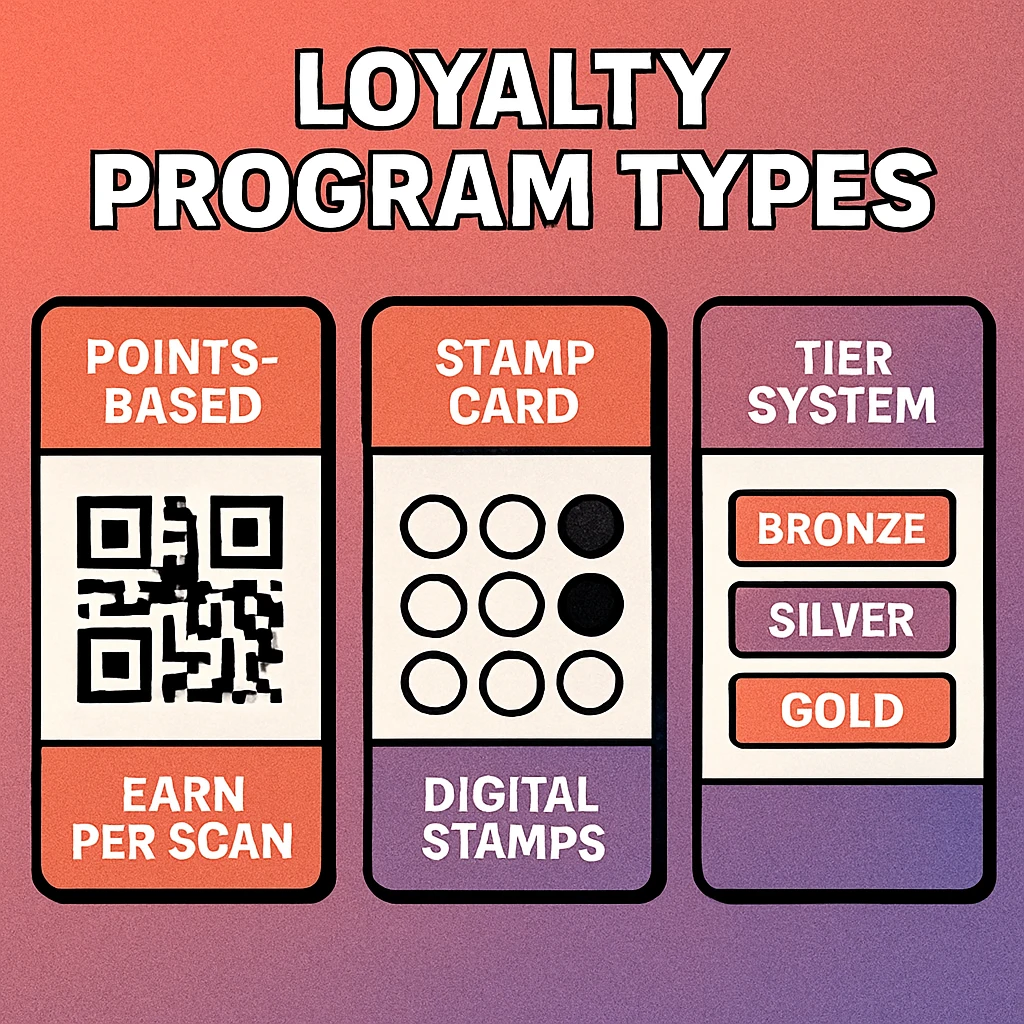
There is no single loyalty model that suits every business. The three most common formats — digital stamp cards, points-based systems, and tier rewards — each have distinct mechanics, ideal use cases, and complexity levels.
Digital Stamp Cards
The digital stamp card is the direct replacement for the paper coffee-shop punch card. Each qualifying scan adds one stamp to the customer’s virtual card. When the card is full — say, after ten visits — the customer unlocks a free item or discount. The rules are immediately understandable: scan, collect, redeem.
This format suits high-frequency, low-average-order businesses: cafes, bakeries, barbershops, and quick-service restaurants. It encourages visit frequency rather than spend size, making it ideal for businesses where the main loyalty lever is getting customers back through the door regularly.
Points-Based Systems
Points programs award credits proportional to spend rather than to visit frequency. A customer who spends £50 earns 500 points; a customer who spends £5 earns 50. Points accumulate over time and can be redeemed for rewards at various thresholds — for example, 500 points for a 10 % discount, 1 000 points for a free product.
This model suits retail, e-commerce, and hospitality businesses where basket sizes vary widely. It naturally rewards higher spenders without penalising occasional visitors, and it gives the business fine-grained control over reward economics via the points-to-value conversion rate.
Tier Rewards
Tier programs layer a progression structure on top of either stamps or points. Customers move from entry level (e.g., Silver) to mid-tier (Gold) to top tier (Platinum) as their cumulative spend or scan count crosses defined thresholds. Each tier unlocks better benefits: higher discount rates, early access to promotions, complimentary upgrades, or priority service.
The psychological driver here is status. Customers near a tier threshold spend more to reach it; customers at a tier spend to maintain it. QR codes make tier verification seamless: the scan not only records a transaction but immediately surfaces the customer’s current tier status so staff can apply the correct benefit at the moment of purchase.
| Program Type | Earns On | Best For | Setup Complexity | Retention Power |
|---|---|---|---|---|
| Stamp Card | Per visit / scan | Cafes, barbershops, QSR | Low | Visit frequency |
| Points-Based | Per £ / $ spent | Retail, hospitality | Medium | Spend value |
| Tier Rewards | Cumulative spend | Premium brands, services | Higher | Status & VIP spend |
The Scan-to-Earn Flow
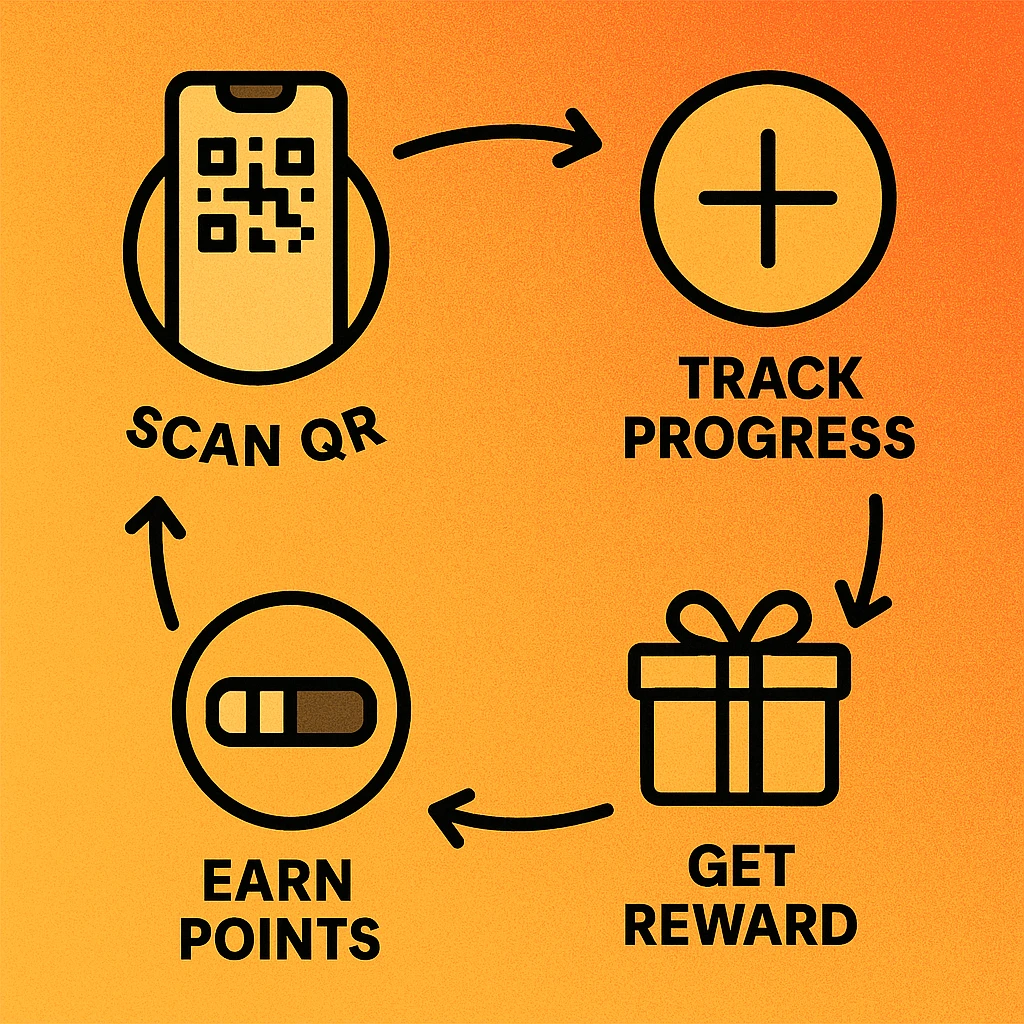
Understanding the mechanics of a QR loyalty scan helps you design a frictionless experience. The flow is short by design: every additional step loses a percentage of customers.
Scan-to-Earn: Step by Step
QR code is displayed. The loyalty QR appears at the point of sale — printed on a counter card, shown on a screen, or printed on a receipt. For scan-by-customer flows, the code is static. For staff-scan flows, the customer’s unique member QR is shown on their phone.
Customer scans. The phone camera opens the QR link. If the customer is already a member, the loyalty page recognises their session. New customers land on a lightweight registration form asking only for email or phone number.
Reward is credited. The platform adds the stamp, points, or tier progress to the account in real time. For points programs, this step can include a purchase amount entry or automatic POS integration.
Confirmation is shown. The customer sees their updated balance, progress toward the next reward, and any available redemptions. A summary can be sent via email or SMS for records.
Reward is redeemed. When a threshold is met, the customer presents a redemption QR code at their next visit. The staff member scans it to apply the discount or free item, and the reward balance resets.
To prevent stamp farming, each loyalty QR scan should be time-stamped and tied to a transaction reference. Limit the number of stamps per IP address or device per day, and consider requiring a minimum purchase value before a stamp is awarded.
QR Code Apps for Mac & Safari
Prefer generating codes without opening a browser tab? These two native Apple apps cover both habits — a full generator on the desktop, and a one-click share button inside Safari.

Retention Benefits of QR Loyalty Programs
The operational benefits of switching from paper to QR are obvious: lower printing costs, instant updates, and no lost cards. But the deeper value lies in data and personalisation.
Every scan creates a timestamped record of customer behaviour: visit frequency, preferred times, spend per visit, and lapse periods. This data lets you trigger precisely targeted outreach. A customer who has not scanned in 30 days can receive a re-engagement offer automatically. A customer approaching a tier threshold can receive a nudge email showing exactly how close they are.
Pairing your loyalty program with targeted offers amplifies these effects significantly. See our guide to QR code coupons and promotions for tactics that work particularly well when combined with loyalty mechanics. Similarly, if you operate a food and beverage business, our article on QR code restaurant menus covers how to integrate loyalty QR codes into the dining experience seamlessly.
- Reduced churn: Customers with an active loyalty balance are significantly less likely to switch to a competitor, as they have accumulated value they would lose.
- Increased average order value: Points-based programs encourage customers to add one more item to cross a reward threshold.
- Zero-party data collection: Registration for the loyalty program provides opt-in contact data for email and SMS marketing, with the customer’s explicit consent.
- Predictable repeat visit cadence: Stamp card programs create a predictable return loop, especially when the card resets automatically and the next stamp feels immediately valuable.
- Word of mouth: Customers who feel rewarded talk about it. A visible QR code at the counter prompts curiosity from bystanders and new customers.
Ready to Launch Your Loyalty Program?
Generate a branded loyalty QR code today. Free to use, instant download in PNG or SVG.
Getting Started: Practical Steps
You do not need expensive software to launch a basic QR loyalty program. The simplest version — a digital stamp card — can be built with a QR code generator, a lightweight web form tool, and a spreadsheet. Here is a minimal viable approach:
- Choose your program type. For most small businesses, start with a digital stamp card: simple rules, easy for customers to understand, and low administrative overhead.
- Set your reward structure. Decide how many stamps equal a reward, and what the reward is. Make the maths obvious and the reward genuinely motivating — a free item typically outperforms a percentage discount.
- Generate your QR code. Create a URL-based QR code pointing to your loyalty landing page. Style it to match your brand colours and add your logo to reinforce recognition.
- Deploy the QR at point of sale. Print it on a countertop card, add it to your receipts, and display it at any physical touchpoint where customers complete a transaction.
- Promote enrolment. Train staff to mention the loyalty program at checkout. Add a sign explaining the benefit in one sentence: “Scan to earn your free coffee after 10 visits.”
- Review and iterate. After the first month, check sign-up rates, scan frequency, and redemption rates. Adjust the reward threshold or offer type if engagement is lower than expected.
As your program grows, consider migrating to a dedicated loyalty platform that offers native QR integration, automated email flows, and POS connectivity. The QR code itself remains the customer-facing interface — only the back-end mechanics change.
Frequently Asked Questions
A QR code loyalty program works by assigning a unique QR code to each customer or visit. When a customer makes a purchase or completes a qualifying action, they scan the QR code — either displayed at the point of sale or printed on a receipt. The scan records the transaction in your loyalty platform, awards points or stamps, and updates the customer’s reward balance in real time. No paper cards or physical tokens are needed.
A digital stamp card works like a traditional paper coffee card: the customer collects a fixed number of stamps (one per visit or purchase) and receives a reward once the card is full. Points-based programs are more flexible — customers earn points proportional to spend, and can redeem them for various rewards at any threshold. Stamp cards are simpler to explain and operate; points programs scale better for businesses with diverse product ranges.
Not necessarily. Many QR loyalty programs use a web-based approach: the customer scans the QR code with their phone camera, which opens a mobile-optimised page where they can log in, register, or track their rewards without downloading anything. App-based programs offer richer features like push notifications and offline access, but the app-free approach removes a significant barrier to customer sign-up.
Tier programs create a progression ladder — for example, Silver, Gold, and Platinum — where customers unlock better rewards, exclusive discounts, or priority service as they spend more. Because the benefits improve with each tier, high-value customers have a strong incentive to maintain or increase their spending to protect their status. QR codes make tier verification instant: the scan reveals the customer’s current tier, so staff can apply the right benefits without manual checks.
Yes. Combining loyalty rewards with targeted QR code coupons is a highly effective retention strategy. Loyalty members can receive personalised coupon QR codes via email or SMS when they hit a spending threshold, on their birthday, or when they have not visited for a set period. This re-engagement approach is covered in detail in our guide to QR code coupons and promotions.