What Is GS1 Digital Link?
Every product sold globally carries a GTIN (Global Trade Item Number) — the number encoded in a traditional 1D barcode like EAN-13 or UPC-A. That barcode has served retail checkouts well for fifty years. But it carries only a number. It cannot link to a product page, cannot surface allergen information for a mobile user, and cannot feed into a real-time traceability system without a separate lookup step.
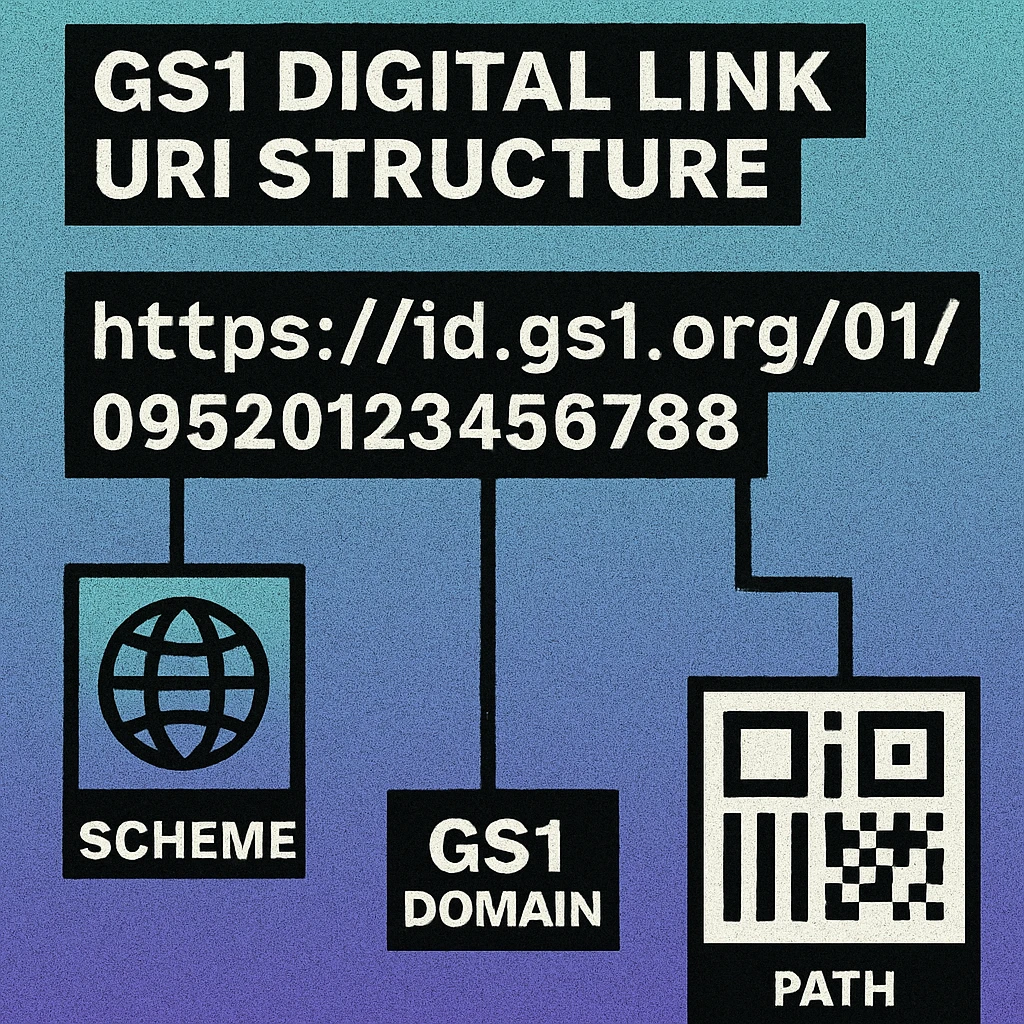
GS1 Digital Link (standardised as ISO/IEC 18975) solves this by encoding GS1 identifiers — including the GTIN — into a standard HTTPS URI and storing that URI inside a QR code. The result is a single physical code that a POS scanner, a smartphone camera, and a supply-chain API can all read — each receiving the data it needs.
For a broader grounding in QR code encoding mechanics, see our pillar guide on QR code technical specifications, which covers version sizing, error correction levels, and data capacity in depth. This article focuses specifically on the GS1 Digital Link layer that sits on top of those fundamentals.
GS1 Digital Link is defined in the GS1 Digital Link Standard v1.3 and ratified as ISO/IEC 18975:2023. It is backed by GS1, the same organisation that maintains the EAN/UPC barcode system used at retail checkouts worldwide.
URI Structure & GTIN Encoding
The GS1 Digital Link URI follows a precise structure built around Application Identifiers (AIs) — the same two-to-four-digit numeric prefixes that appear in parentheses on GS1-128 logistics barcodes. In a Digital Link URI, these AIs become path segments of an HTTPS URL.
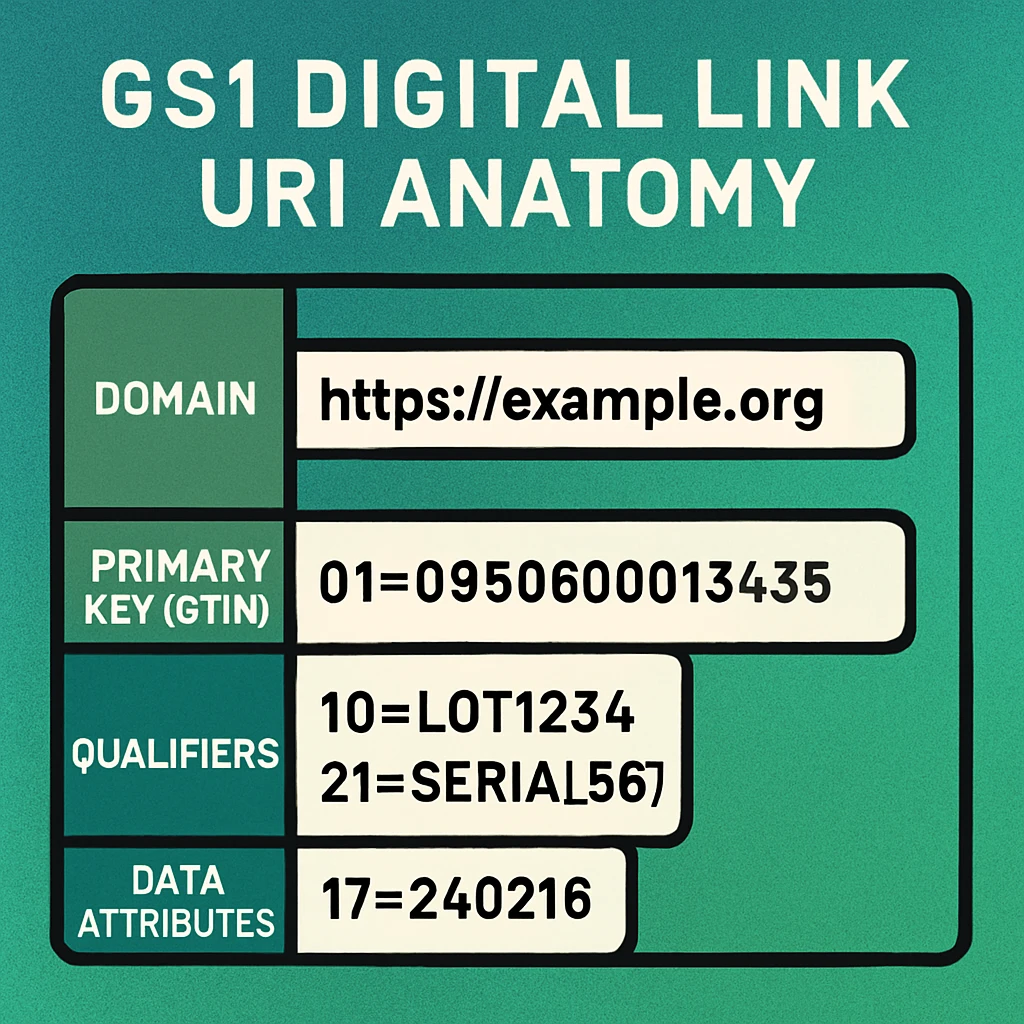
The primary key is always the GTIN, encoded with AI 01. A minimal Digital Link URI looks like this:
https://id.example.com/01/09506000134352
The domain (id.example.com) is the brand's resolver domain, registered with GS1. The path segment /01/ declares that the following value is a 14-digit GTIN. GTINs shorter than 14 digits are zero-padded on the left.
Additional qualifiers append to the primary key path, separated by further AI segments:
https://id.example.com/01/09506000134352/10/AB1234/17/260331
In this example: /10/AB1234 is the batch/lot number (AI 10) and /17/260331 is the expiry date in YYMMDD format (AI 17). Serial number (AI 21), country of origin, and dozens of other data attributes can be appended in the same pattern.
| Application Identifier | Data Element | Position in URI | Example Value |
|---|---|---|---|
| AI 01 | GTIN (14 digits) | Primary key — always first | /01/09506000134352 |
| AI 10 | Batch / Lot Number | Qualifier segment | /10/AB1234 |
| AI 17 | Expiry Date (YYMMDD) | Qualifier segment | /17/260331 |
| AI 21 | Serial Number | Qualifier segment | /21/SN00987 |
| AI 8013 | Global Model Number (GMN) | Qualifier segment | /8013/1234ABC |
The full URI is stored in a standard QR code (typically error correction level M or Q). The QR code itself requires no special encoding mode — it is simply a URL. Any modern smartphone camera can scan it.
Resolver Architecture
The resolver is the server-side infrastructure that receives HTTP requests from scanners and routes them to the appropriate response. When a smartphone camera scans a GS1 Digital Link QR code, it makes an HTTP GET request to the URI inside the code. The resolver inspects the request — specifically the HTTP Accept header and the URI path — and decides where to redirect the user.
A well-implemented resolver supports link type negotiation via the HTTP Link response header. The GS1 Digital Link standard defines a vocabulary of link types, including:
- gs1:pip — Product Information Page (consumer-facing landing page)
- gs1:certificationInfo — sustainability or certification records
- gs1:traceability — batch-level supply-chain data
- gs1:verificationService — anti-counterfeiting and authentication
- gs1:allergenInfo — allergen and nutritional information
- gs1:epcis — EPCIS traceability event data for supply chain systems
Brands can host their own resolver or delegate to a third-party resolver service. GS1 also operates a global resolver at https://id.gs1.org/ that brands can use as a fallback.
The resolver does not need to return a redirect for every request. For API clients sending Accept: application/json, the resolver can respond with a JSON-LD document containing structured product data. This makes GS1 Digital Link a natural fit for connected packaging and IoT data pipelines.
QR Code Apps for Mac & Safari
Prefer generating codes without opening a browser tab? These two native Apple apps cover both habits — a full generator on the desktop, and a one-click share button inside Safari.


One Code, Multiple Uses
The defining promise of GS1 Digital Link is that a single printed QR code can serve completely different purposes depending on who is scanning it and how.
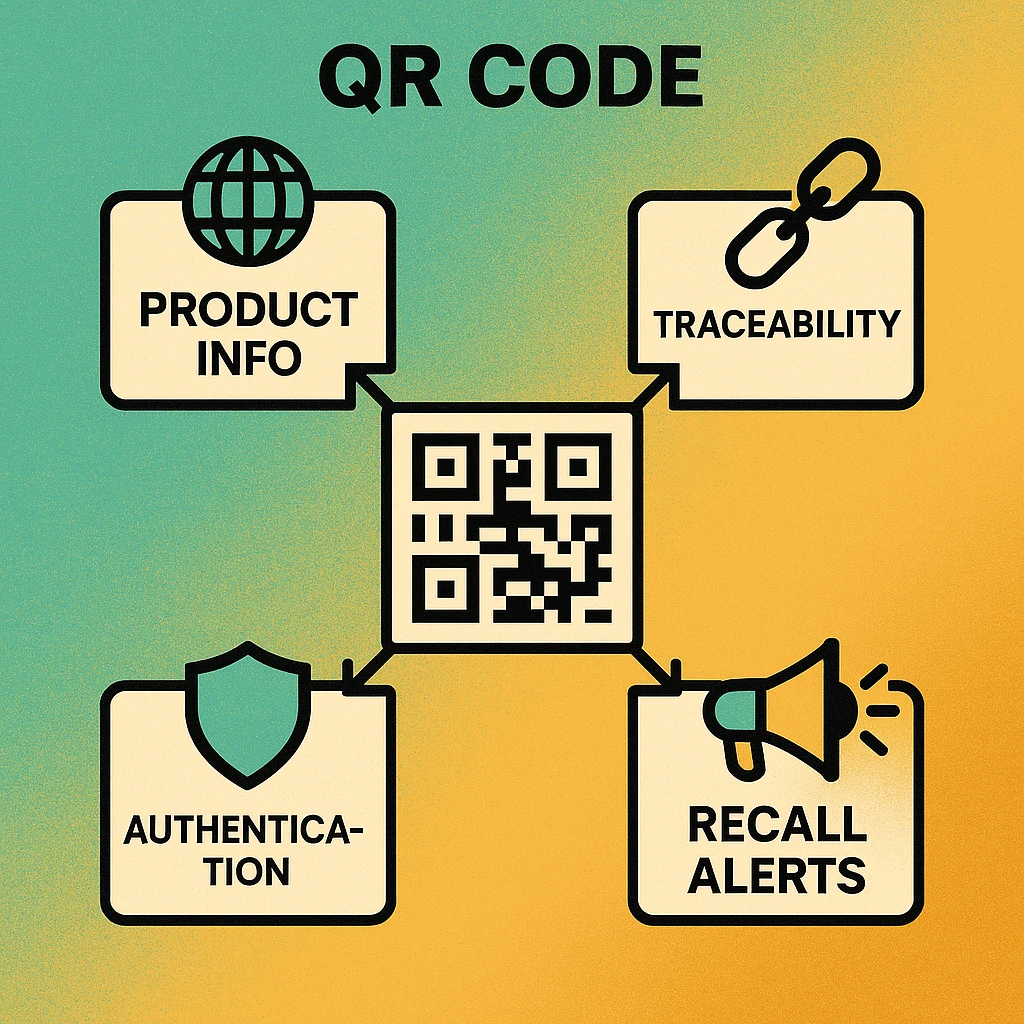
Consider a food product with a GS1 Digital Link QR code printed on its packaging:
- Consumer scan (smartphone camera): The resolver detects a browser user agent and redirects to the product information page — ingredients, allergens, recipes, sustainability story.
- Retail POS scan: The scanner extracts the GTIN from the URI path (AI 01) and processes checkout identically to a legacy EAN-13 barcode. No resolver call required for basic checkout.
- Supply-chain traceability system: An EPCIS-enabled API client sends a request with appropriate Accept headers. The resolver returns batch-level provenance data — farm of origin, processing date, cold-chain events.
- Authentication check: A brand protection platform queries the serial number (AI 21) against a registry and confirms whether the unit is genuine.
This multi-purpose capability directly supports requirements emerging from legislation like the EU Digital Product Passport, which mandates machine-readable product data accessible via a 2D code. GS1 Digital Link is the leading candidate technical implementation for DPP compliance.
For practical guidance on printing GS1 Digital Link codes on retail packaging, see our article on QR codes for product packaging, which covers size, placement, and quiet zone requirements for consumer goods.
Build GS1-Ready QR Codes
Generate URL QR codes and download as high-resolution PNG or SVG for packaging integration. Free, no account needed.
Sunrise 2027
Sunrise 2027 is the GS1 industry programme that sets 2027 as the target date by which all point-of-sale scanning systems globally should be capable of reading 2D symbologies — specifically GS1 DataMatrix and GS1 QR codes (Digital Link) — alongside legacy 1D barcodes.
The challenge is enormous: hundreds of thousands of retail checkout lanes worldwide currently rely on laser scanners tuned to 1D barcodes. Upgrading to 2D-capable imagers requires both hardware investment and POS software updates to parse Digital Link URIs and extract GTINs correctly.
GS1 has been coordinating a phased rollout with major retailers, scanner manufacturers, and software vendors. Key milestones include:
- 2023–2025: Pilot programmes with leading grocery retailers in Europe, North America, and Asia-Pacific. Proof-of-concept deployments on fresh produce and pharmaceuticals.
- 2025–2026: POS scanner vendors certifying 2D reading capability as standard. Retailer upgrade programmes accelerating.
- 2027: Target date for industry-wide readiness. After this point, brands can begin replacing legacy 1D barcodes on new packaging runs with GS1 Digital Link QR codes — confident that checkout systems can process them.
Brands launching new packaging SKUs in 2025 or 2026 should design with a dual-symbol approach — retaining the EAN/UPC barcode for current POS compatibility while adding a GS1 Digital Link QR code for consumer engagement and supply-chain data. After Sunrise 2027, the 1D barcode can be retired in favour of the QR code alone.
Packaging Implementation Checklist
Implementing GS1 Digital Link correctly requires coordination across brand, supply chain, and digital teams. The following checklist summarises the key steps:
- Obtain a GS1 Company Prefix if you do not already have one. This is the foundation for constructing valid GTINs.
- Assign GTINs to all products that will carry Digital Link QR codes.
- Register or configure a resolver domain. This can be your own infrastructure or a third-party GS1 resolver service. Register the domain with GS1 so it appears in the global resolver registry.
- Define link types and endpoints for each GTIN — product information page URL, traceability endpoint, allergen page, and so on.
- Generate the Digital Link URIs including any qualifiers (batch, serial, expiry) required for your use case.
- Encode the URIs into QR codes using error correction level M or Q. Minimum print size is 10×10 mm for packaging; 20×20 mm recommended for reliable consumer scanning at arm's length.
- Verify with a GS1-certified verifier before committing to a print run. The GS1 Digital Link Verifier tool checks URI syntax, resolver response, and QR code print quality against the standard.
GS1 Digital Link is not a proprietary technology — it is an open ISO standard. Any QR code generator that produces a standard URL QR code can encode a valid Digital Link URI. The business logic lives entirely in the resolver and the URI structure, not in the QR code itself.
Frequently Asked Questions
GS1 Digital Link (ISO/IEC 18975) is an open standard that encodes GS1 identifiers such as GTINs, batch numbers, and serial numbers into a standard HTTPS URI. When scanned, the URI is resolved by a server that routes the consumer, retailer, or supply-chain system to the most relevant endpoint — a product page, traceability record, or authentication check — all from a single QR code.
Sunrise 2027 is the GS1 industry milestone by which all point-of-sale systems worldwide should be capable of scanning 2D codes such as GS1 Digital Link QR codes alongside traditional 1D barcodes. After 2027, retailers and brand owners can begin transitioning product packaging from legacy EAN/UPC barcodes to GS1 Digital Link QR codes without risking checkout failures.
A GTIN is encoded in the path segment of the URI using Application Identifier 01. The format is: https://[domain]/01/[14-digit-GTIN]. For example, a product with GTIN 09506000134352 would appear as https://example.com/01/09506000134352. Additional qualifiers like batch/lot (AI 10) or serial number (AI 21) are appended as further path segments.
Yes, that is the long-term goal of the GS1 Sunrise 2027 initiative. A GS1 Digital Link QR code encodes the same GTIN data that a 1D barcode carries, so a compliant POS scanner can extract the GTIN and process it identically to an EAN-13 or UPC-A. At the same time, consumers can scan the same code with their smartphone to reach product information, allergens, or sustainability data.