What Is the EU Digital Product Passport?
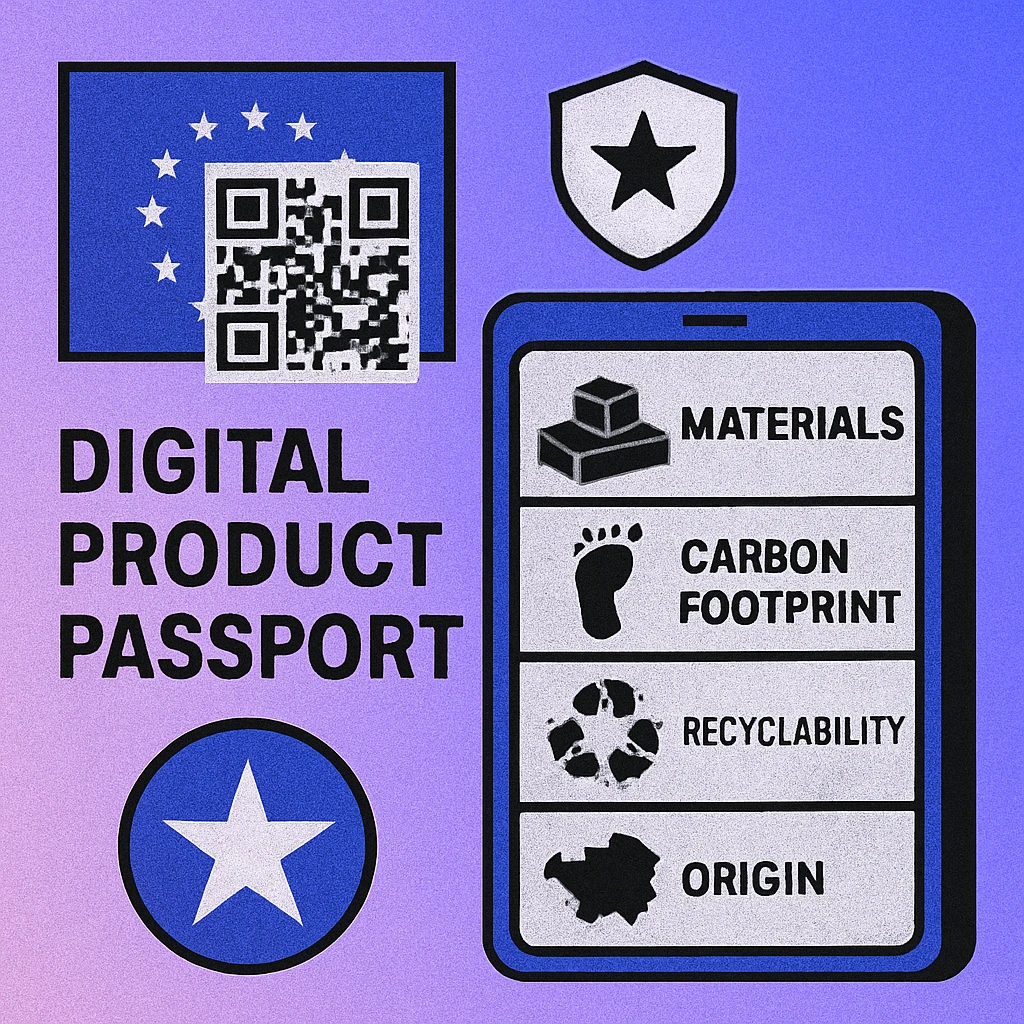
The EU Digital Product Passport (DPP) is a structured digital record that will be required for virtually every physical product sold in the European Union. Mandated by the Ecodesign for Sustainable Products Regulation (ESPR), adopted in 2024, the DPP requires manufacturers to provide consumers, recyclers, and regulators with transparent, machine-readable data about a product's environmental impact, composition, and lifecycle.
Think of it as a product's complete biography — from the raw materials used in manufacturing through to end-of-life recycling instructions — stored in a standardized digital format and accessible to anyone who scans the product. The goal is ambitious: the European Commission wants to eliminate greenwashing, enable informed consumer choices, and accelerate the transition to a circular economy where materials are reused rather than discarded.
The ESPR does not exist in isolation. It builds on the existing EU Ecodesign Directive (which previously covered only energy-related products) and expands its scope to nearly all physical goods. It also connects to the EU's broader European Green Deal and Circular Economy Action Plan, which aim to make sustainable products the norm across the single market by 2030.
For businesses, the implications are significant. Every product placed on the EU market — regardless of where it was manufactured — must carry a DPP. Non-compliance means the product cannot legally be sold in the EU. For a broader look at how QR codes are transforming industries, see our complete guide to QR code use cases.
The Digital Product Passport is not optional. Under ESPR, any product sold in the EU — including imports — must carry a DPP. Non-compliant products will be blocked from the EU market.
Why QR Codes Are the Chosen Technology
When the European Commission evaluated how to make Digital Product Passport data physically accessible on products, several technologies were considered: NFC chips, RFID tags, traditional barcodes, and QR codes. QR codes emerged as the primary carrier, and the reasons are both practical and economic.
Universal scanning capability. Every smartphone manufactured in the last decade can scan a QR code using its built-in camera. No special hardware, no dedicated app, no proprietary reader. A consumer in a retail store, a recycling facility worker, or a customs inspector can all access the same DPP data instantly. NFC and RFID, by contrast, require proximity, specialized chips, and readers that not every stakeholder has.
Near-zero marginal cost. Printing a QR code on packaging costs virtually nothing. It is ink on a surface — the same ink already used for branding and regulatory text. Embedding an NFC chip or RFID tag adds $0.05 to $0.50 per unit, which becomes prohibitive at scale across millions of SKUs. For more on how QR codes integrate with physical packaging, read our guide to QR codes on product packaging.
Durability across surfaces. QR codes work on cardboard, plastic, metal, glass, fabric, and even laser-etched onto electronic components. They survive printing imperfections thanks to built-in error correction, and they can be as small as 1 cm or as large as a billboard.
GS1 Digital Link compatibility. The EU has endorsed the GS1 Digital Link standard as the technical backbone for DPP QR codes. This standard turns a product's unique identifier into a web URI that can be encoded directly into a QR code — bridging the physical product to its digital data in a single scan. More on this in the GS1 Digital Link section below.
The combination of these factors makes the eu digital product passport qr code approach not just the most practical solution, but effectively the only one that works at the scale the regulation demands — across all industries, all product categories, and all stakeholders in the supply chain.
What Data Must Be Included
The specific data requirements for each Digital Product Passport will vary by product category (batteries have different requirements than textiles), but the ESPR framework mandates several core data fields that apply broadly. Here is what every DPP is expected to contain:
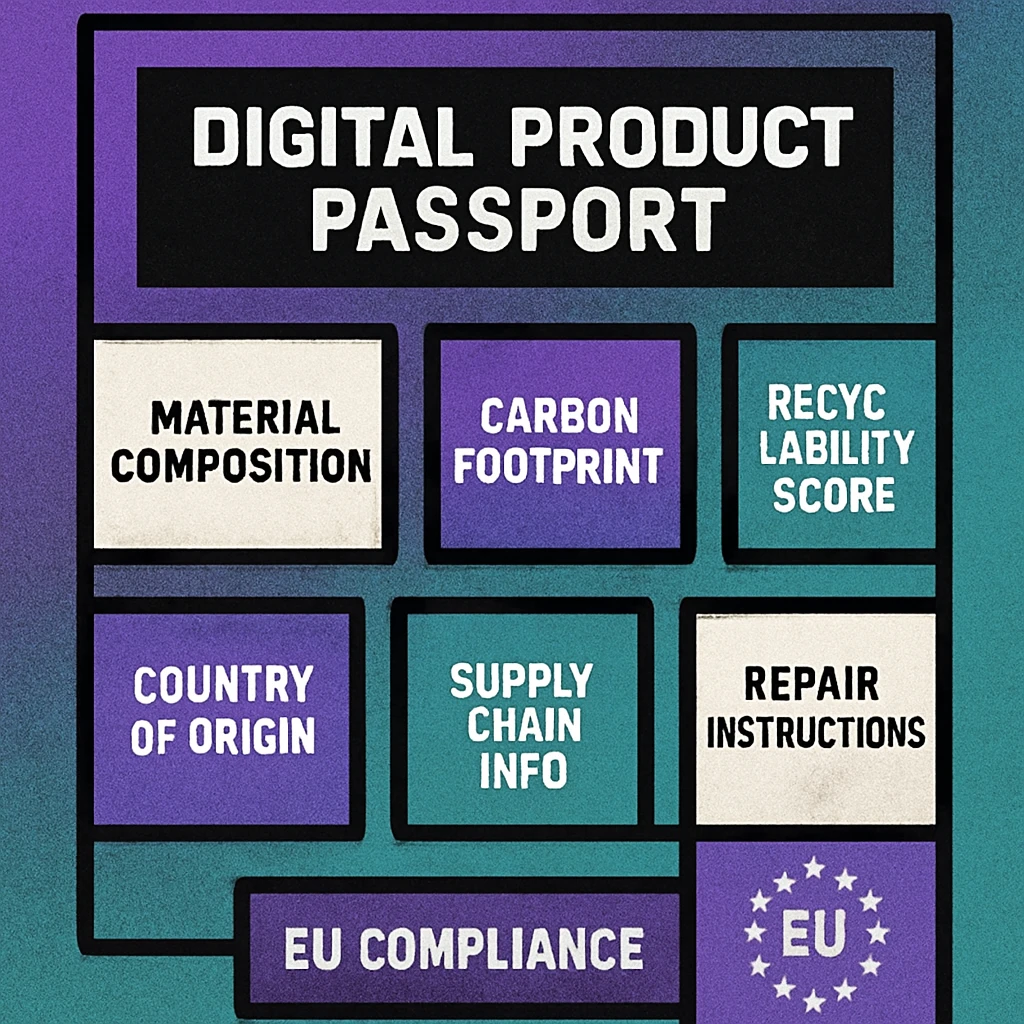
| Data Category | What It Includes | Who Benefits |
|---|---|---|
| Materials | Full bill of materials, substances of concern, recycled content percentage | Recyclers, regulators |
| Carbon Footprint | Lifecycle carbon emissions from raw material extraction through disposal | Consumers, policymakers |
| Recyclability | Disassembly instructions, recyclable components, waste classification codes | Recycling facilities |
| Origin & Supply Chain | Manufacturing location, supplier information, country of origin for key materials | Customs, consumers |
| Repair Information | Spare parts availability, repair manuals, expected product lifespan | Consumers, repair shops |
| Compliance | CE marking data, conformity declarations, applicable standards | Regulators, importers |
| Unique Identifier | Serialized product ID linked to GS1 Digital Link or equivalent URI | All stakeholders |
The DPP data is not stored inside the QR code itself — a QR code's data capacity is far too limited for this volume of information. Instead, the QR code contains a URI (web address) that points to the full product passport record hosted on a secure, interoperable data platform. When scanned, the QR code directs the user to a webpage or API endpoint where the complete DPP data is displayed or delivered in a machine-readable format.
This is fundamentally a dynamic QR code architecture: the code on the product stays the same, but the data it points to can be updated over time — for example, when repair parts availability changes or when new recycling guidelines are issued.
The QR code does not store the passport data directly. It contains a web URI that links to the full Digital Product Passport record on a hosted platform. This means the data can be updated without changing the physical QR code on the product.
Which Industries Are Affected First
The ESPR regulation does not apply to all products simultaneously. The European Commission is using a phased rollout, starting with product categories that have the highest environmental impact and the most mature data standards.
Batteries — February 2027
The EU Battery Regulation (2023/1542) is the first sector-specific law requiring a Digital Product Passport. From February 2027, every industrial battery, EV battery, and light means of transport battery sold in the EU must carry a QR code linking to its passport. This includes data on raw material sourcing (cobalt, lithium), carbon footprint, recycled content, expected lifespan, and state-of-health parameters. Battery manufacturers like CATL, LG Energy, and Samsung SDI are already building compliance infrastructure.
Textiles — 2028 (Expected)
The fashion and textile industry is next. Product passports for garments and textiles will require disclosure of fiber composition, country of manufacturing, chemical treatments, water usage, and instructions for recycling or responsible disposal. This directly targets fast fashion's environmental impact and aims to give consumers verifiable sustainability data instead of vague marketing claims.
Electronics — 2028–2029 (Expected)
Consumer electronics, including smartphones, laptops, and home appliances, will need DPPs that detail repairability scores, spare parts availability, expected lifespan, energy efficiency ratings, and end-of-life recycling instructions. This aligns with the EU's existing Right to Repair directive and creates a single data source for all product sustainability information.
All Products — 2030 (Projected)
By 2030, the European Commission aims to extend DPP requirements to virtually all physical products sold in the EU market. The specific delegated acts for each product category will be published on a rolling basis, but the direction is clear: if you sell a physical product in the EU, it will eventually need a Digital Product Passport accessible via QR code.
Start Building QR Codes for Product Compliance
Generate QR codes that link to product data, sustainability records, or any URL. Free, instant, no account required.
QR Code Apps for Mac & Safari
Prefer generating codes without opening a browser tab? These two native Apple apps cover both habits — a full generator on the desktop, and a one-click share button inside Safari.


How to Prepare Your Business
Even if your product category's DPP deadline is years away, the compliance infrastructure takes time to build. Companies that start early will have a competitive advantage — both in meeting deadlines and in using product transparency as a marketing differentiator. Here is a practical implementation roadmap:
DPP Implementation Roadmap
Audit your product data. Identify what sustainability data you already collect (materials, sourcing, emissions) and what gaps exist. Most companies discover they have 40–60% of the required data scattered across ERP systems, supplier contracts, and compliance documents.
Map your supply chain. DPP data extends beyond your own manufacturing. You will need material composition, origin, and carbon data from suppliers at every tier. Start requesting this data now and build it into procurement contracts.
Choose a DPP data platform. Several platforms are emerging to host Digital Product Passport data in compliance with EU interoperability standards. Evaluate options from GS1-certified providers, industry consortiums, or build your own if you have the resources. The platform must support structured data formats and provide stable URIs for each product.
Implement GS1 Digital Link identifiers. Register your products with GS1 and generate Digital Link URIs that embed your GTIN (Global Trade Item Number) into a web-compatible format. This URI becomes the content encoded in your QR code.
Integrate QR codes into packaging. Work with your packaging design team to add QR codes that encode the GS1 Digital Link URI. Follow QR code packaging best practices: ensure adequate size (minimum 1.5 cm), sufficient quiet zone, and high contrast for reliable scanning.
Test and validate. Scan your QR codes across multiple devices and lighting conditions. Verify that the linked DPP data loads correctly, is formatted according to EU standards, and is accessible to all stakeholder types (consumers, recyclers, regulators). Run a pilot batch before full production rollout.
Companies that sell across multiple product categories should establish a centralized DPP program rather than treating each category separately. The underlying data infrastructure, QR code generation pipeline, and GS1 integration will be shared across all product lines.
GS1 Digital Link and QR Codes
The GS1 Digital Link standard is the technical bridge between the physical QR code on a product and its Digital Product Passport data online. Understanding how it works is essential for any business preparing for DPP compliance.
What Is GS1 Digital Link?
Traditionally, GS1 standards (like the EAN/UPC barcodes on grocery products) encode a product identifier — the GTIN (Global Trade Item Number) — as a numeric string readable only by specialized barcode scanners connected to retail point-of-sale systems. The data goes nowhere except the retailer's inventory database.
GS1 Digital Link transforms that identifier into a web URI. For example, a product with GTIN 05412345000013 would have a Digital Link URI like:
https://id.example.com/01/05412345000013/10/LOT123
This URI is both human-readable (it can be typed into a browser) and machine-readable (it resolves to structured data). When encoded in a QR code and scanned, it can direct the user to the product's DPP data, manufacturer website, recall notices, or sustainability information — all depending on what the resolver at that domain is configured to serve.
How It Works with DPP QR Codes
Here is the flow in practice:
- Product registration: The manufacturer registers the product with GS1 and receives a GTIN. They also set up a resolver service (either their own or through a GS1-certified provider) that maps the Digital Link URI to various data endpoints.
- URI generation: The GS1 Digital Link URI is generated, potentially including batch/lot numbers and serial numbers for item-level traceability.
- QR code encoding: The URI is encoded into a QR code and printed on the product or its packaging.
- Consumer scan: When a consumer or inspector scans the QR code, their device opens the URI. The resolver detects the request context (browser, API call, specific application) and directs to the appropriate response — a consumer-friendly DPP webpage, a machine-readable JSON-LD response, or a regulatory compliance endpoint.
The beauty of this architecture is that one QR code serves multiple purposes. The same GS1 Digital Link QR code that a consumer scans for sustainability information can be scanned at a recycling facility to retrieve disassembly instructions, or at a customs checkpoint to verify compliance documentation. The resolver decides what data to show based on who is asking.
This is a major upgrade from traditional approaches where products might need separate QR codes for marketing, compliance, and logistics. The GS1 Digital Link collapses all of these into a single, standardized identifier. For more on the technical capabilities of QR codes, see our complete QR code guide.
Frequently Asked Questions
The EU Digital Product Passport (DPP) is a structured digital record mandated by the Ecodesign for Sustainable Products Regulation (ESPR). It requires manufacturers to attach machine-readable data — including materials, carbon footprint, recyclability, and repair instructions — to every product sold in the EU, accessible via a QR code.
The rollout is phased by industry. Batteries must comply by February 2027. Textiles and electronics are expected to follow in 2028. By 2030, the regulation is projected to cover virtually all physical products sold in the EU market.
QR codes were chosen because they are universally scannable with any smartphone camera, cost virtually nothing to print, and work on any surface or packaging material. NFC and RFID require special readers or chips, adding cost and complexity. QR codes also support the GS1 Digital Link standard, which encodes a web URI that resolves to the product's full passport data.
GS1 Digital Link is an international standard that embeds a product's unique identifier (GTIN) into a web-compatible URI. When encoded in a QR code, this URI can resolve to the Digital Product Passport data, product webpage, recall notices, or sustainability information — all from a single scan. It replaces traditional GS1 barcodes with a future-proof, web-native format.
Yes. Any company that sells physical products in the EU market must comply, regardless of where the company is headquartered or where the product is manufactured. This includes manufacturers, importers, and distributors. Non-compliance can result in products being blocked from EU market entry.