The Problem at Toyota (1994)
In the early 1990s, Japanese manufacturing was running into a wall. The one-dimensional barcodes used to track parts on assembly lines could only hold about 20 characters of data. For a company like Toyota, which managed thousands of components across dozens of suppliers, that was not nearly enough.
Workers at Toyota's production facilities had to scan multiple barcodes per part just to capture basic information — part number, batch, origin, destination. The process was slow, error-prone, and becoming a genuine bottleneck on lines that were otherwise optimized down to the second.
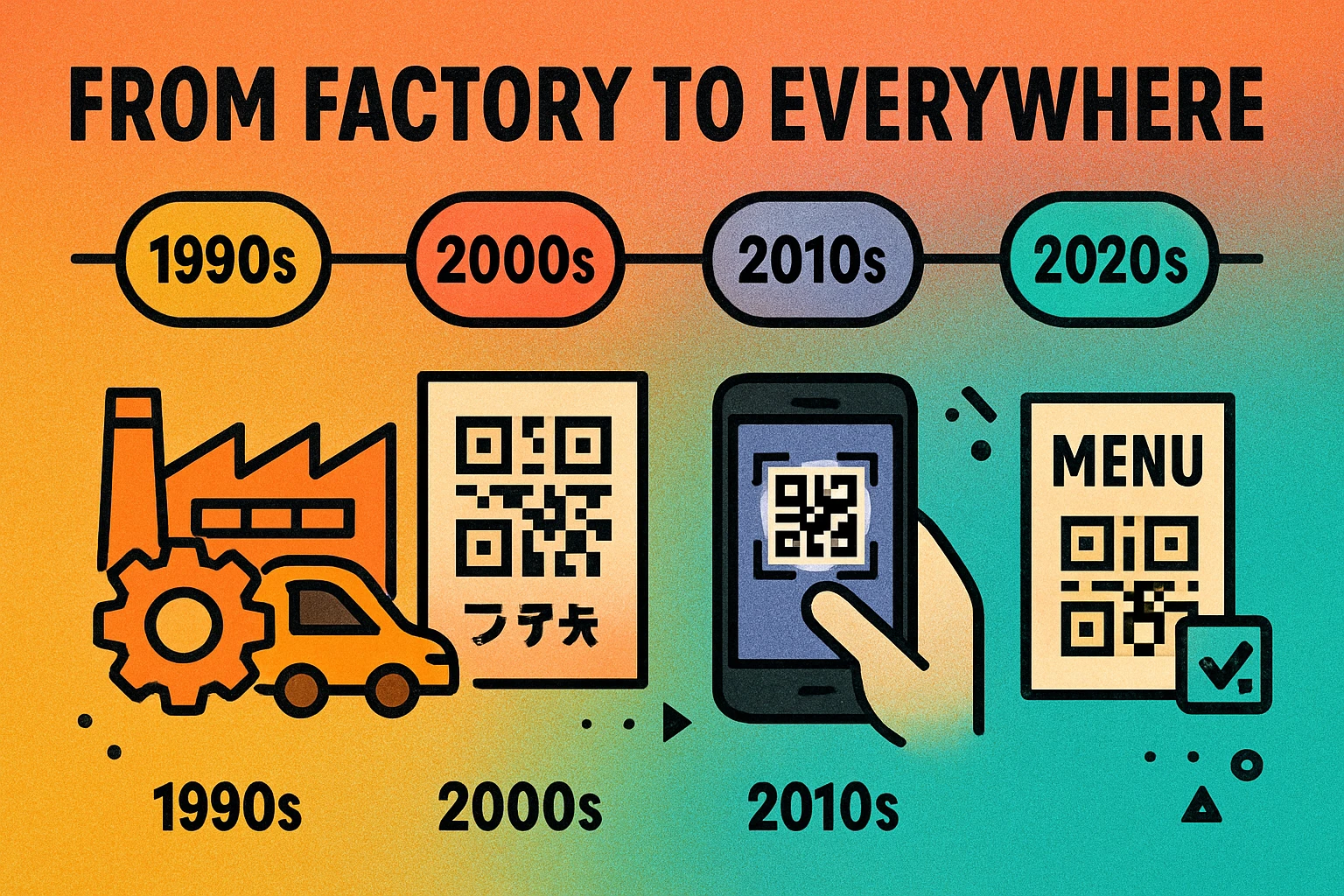
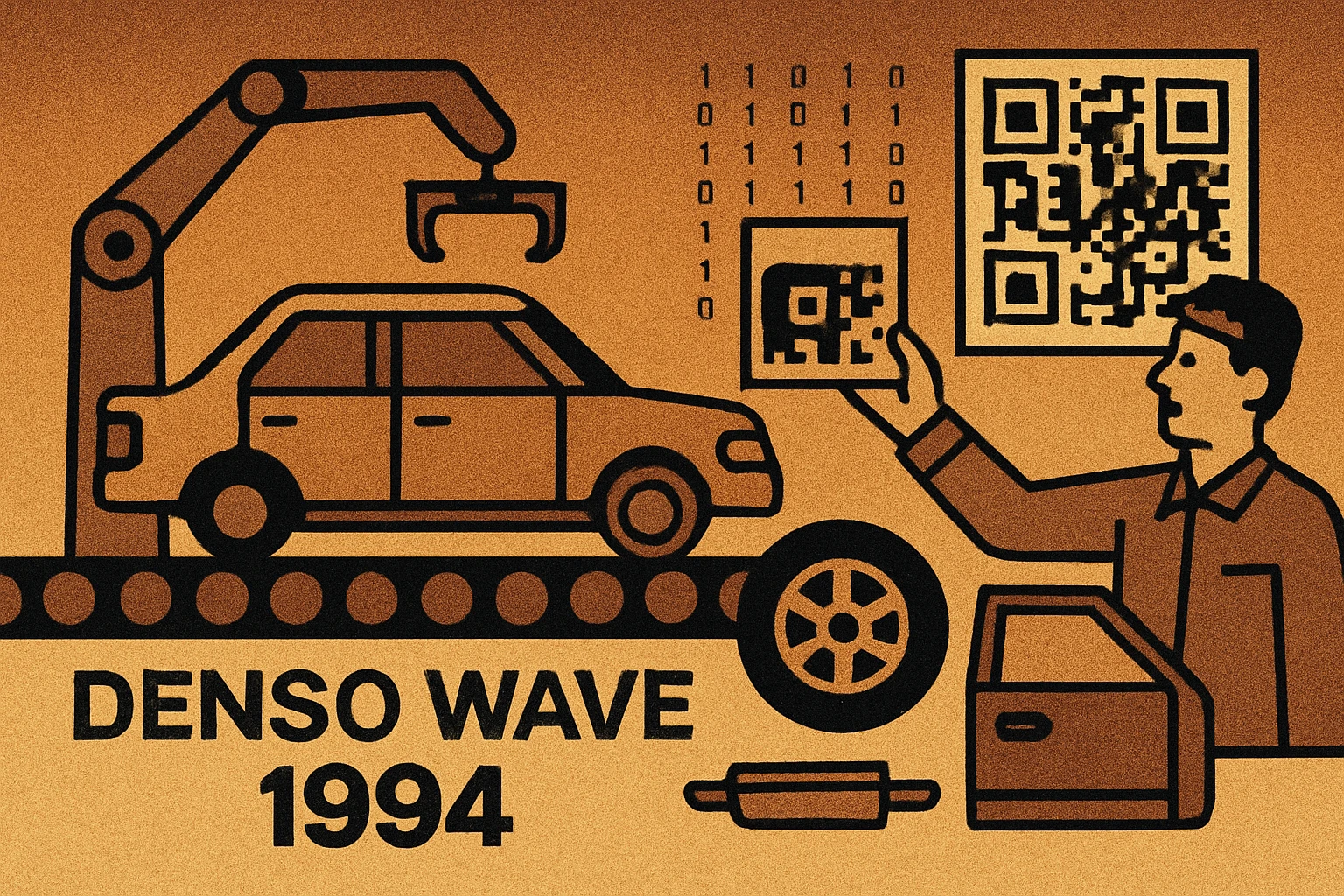
Toyota turned to Denso Wave, a subsidiary of the Toyota Group that specialized in automatic identification technology. The brief was straightforward: build a two-dimensional code that can hold more data and be read faster than anything on the market. If you want to understand the technical differences between traditional barcodes and QR codes, our QR code vs barcode comparison covers that in detail.
The Invention: Masahiro Hara's Breakthrough
The project landed on the desk of Masahiro Hara, a Denso Wave engineer. Hara and his small team spent over a year developing what would become the QR code. The design challenges were significant: the code needed to encode far more data than a barcode, scan reliably even when partially damaged, and — most critically — read fast enough to keep pace with Toyota's high-speed production lines.
Hara's key insight was the finder pattern — the three distinctive squares in the corners of every QR code. These squares allow a scanner to instantly determine the code's position, size, and angle, regardless of orientation. A scanner does not need to align the code perfectly; it finds those three corners and calculates everything else from there.
The name "QR" stands for Quick Response. It was chosen specifically because the code's primary design goal was speed — not capacity, not size, but how fast a scanner could decode it. A QR code can be read roughly ten times faster than a traditional barcode.
The result, finalized in 1994, was a square matrix of black and white modules that could store up to 7,089 numeric characters or 4,296 alphanumeric characters. It included built-in error correction based on Reed-Solomon codes, meaning the data could still be recovered even if up to 30% of the code was obscured or damaged. To learn how QR codes actually work under the hood, read our complete guide to what a QR code is.
Compared to the one-dimensional barcodes it replaced, the QR code was a generational leap: hundreds of times more data capacity, omnidirectional scanning, and built-in damage tolerance. Toyota's production lines had their solution.
The Decision That Changed Everything
What happened next is arguably more important than the invention itself. Denso Wave held the patent on QR code technology — and chose not to enforce it.
In 1999, Denso Wave released the QR code specification as an open standard, declaring it royalty-free. Anyone could generate, print, and scan QR codes without paying licensing fees. The patent still exists (Denso Wave maintains it to this day), but the company made a deliberate strategic decision to let the technology spread freely.
This decision is the single biggest reason QR codes became ubiquitous. Had Denso Wave locked the technology behind licensing agreements — as many companies did with competing 2D barcode formats like Data Matrix or PDF417 — the history of QR codes would look very different. The format was standardized as ISO/IEC 18004 in 2000, giving it international credibility and ensuring interoperability across devices and software.
Open standards compound. Because QR codes were free to use, every phone manufacturer, software developer, and advertiser could adopt them without negotiation. This created a network effect that no proprietary format could match. The technology won not because it was technically superior to every alternative, but because it had zero friction to adopt.
Early Adoption in Japan (2000–2009)
Japan was the first country to embrace QR codes beyond the factory floor. By the early 2000s, Japanese mobile carriers — led by NTT DoCoMo — began integrating QR code readers into their phones. In 2002, Sharp released the first mobile phone with a built-in QR code scanner, the J-SH09. This was a pivotal moment: for the first time, ordinary consumers could scan QR codes without specialized hardware.
Japanese advertisers jumped on the opportunity. By the mid-2000s, QR codes appeared on magazine ads, product packaging, train station posters, business cards, and even gravestones. They became a bridge between the physical and digital worlds in a country that was already deeply integrated with mobile internet.
Several factors made Japan uniquely fertile ground for QR adoption:
Why Japan Adopted QR Codes First
Mobile internet was mainstream early. Japan's i-mode system, launched in 1999, gave millions of people web access on their phones years before the smartphone era. QR codes offered a fast way to type URLs on tiny keypads.
Cultural comfort with technology. Japanese consumers were accustomed to adopting new tech quickly. Scanning a code on a poster felt natural, not strange.
Denso Wave was a local company. QR codes had strong institutional support from Japanese industry associations and the government, which accelerated standardization and deployment.
Carrier support. NTT DoCoMo, KDDI, and SoftBank all built QR scanning into their phone software, creating an installed base of hundreds of millions of scanners.
By 2007, QR codes were so common in Japan that they were essentially invisible — part of the background infrastructure of daily life. The rest of the world, however, had barely noticed.
Global Expansion: The Smartphone Era (2010–2019)
Outside Japan, QR codes had a rocky start. Early adopters in the US and Europe experimented with them around 2010–2012, but the user experience was poor. Scanning required downloading a separate app, the codes often led to non-mobile-optimized websites, and many campaigns used QR codes as novelty rather than utility. Marketing blogs declared them dead by 2014.
Several things changed to reverse that trajectory:
Apple integrated a QR scanner into iOS 11 in 2017. This was the tipping point. With the iPhone camera app able to read QR codes natively — no third-party app required — the friction that had killed earlier adoption disappeared overnight. Google followed with native support in Android's camera app shortly after.
Meanwhile, in China, QR codes were becoming the backbone of mobile payments. WeChat Pay and Alipay, both launched in the early 2010s, built their entire payment infrastructure around QR codes. By 2018, Chinese consumers were using QR codes to pay for everything from street food to rent. China processed over $15 trillion in QR-based mobile payments in 2019 alone, proving that the technology could scale to national infrastructure level.
India followed a similar path with its Unified Payments Interface (UPI), which used QR codes to enable instant bank-to-bank transfers. By the late 2010s, QR-based payments were displacing cash in major Asian economies. For current data on QR code adoption worldwide, see our 2026 QR code statistics roundup.
Make Your Own QR Code in Seconds
No signup. No expiration. No scan limits. Paste a URL and download instantly.
COVID-19: The Great Acceleration (2020)
If native camera support was the tipping point, the pandemic was the explosion. When COVID-19 forced businesses worldwide to eliminate shared physical surfaces, QR codes became the default solution almost overnight.
Restaurants replaced paper menus with QR codes on tables. Governments issued QR-based vaccination certificates. Offices used QR codes for contactless check-in. Churches, museums, gyms, and doctors' offices all adopted them within months. The technology that marketing blogs had declared dead in 2014 was suddenly on every surface in every country.
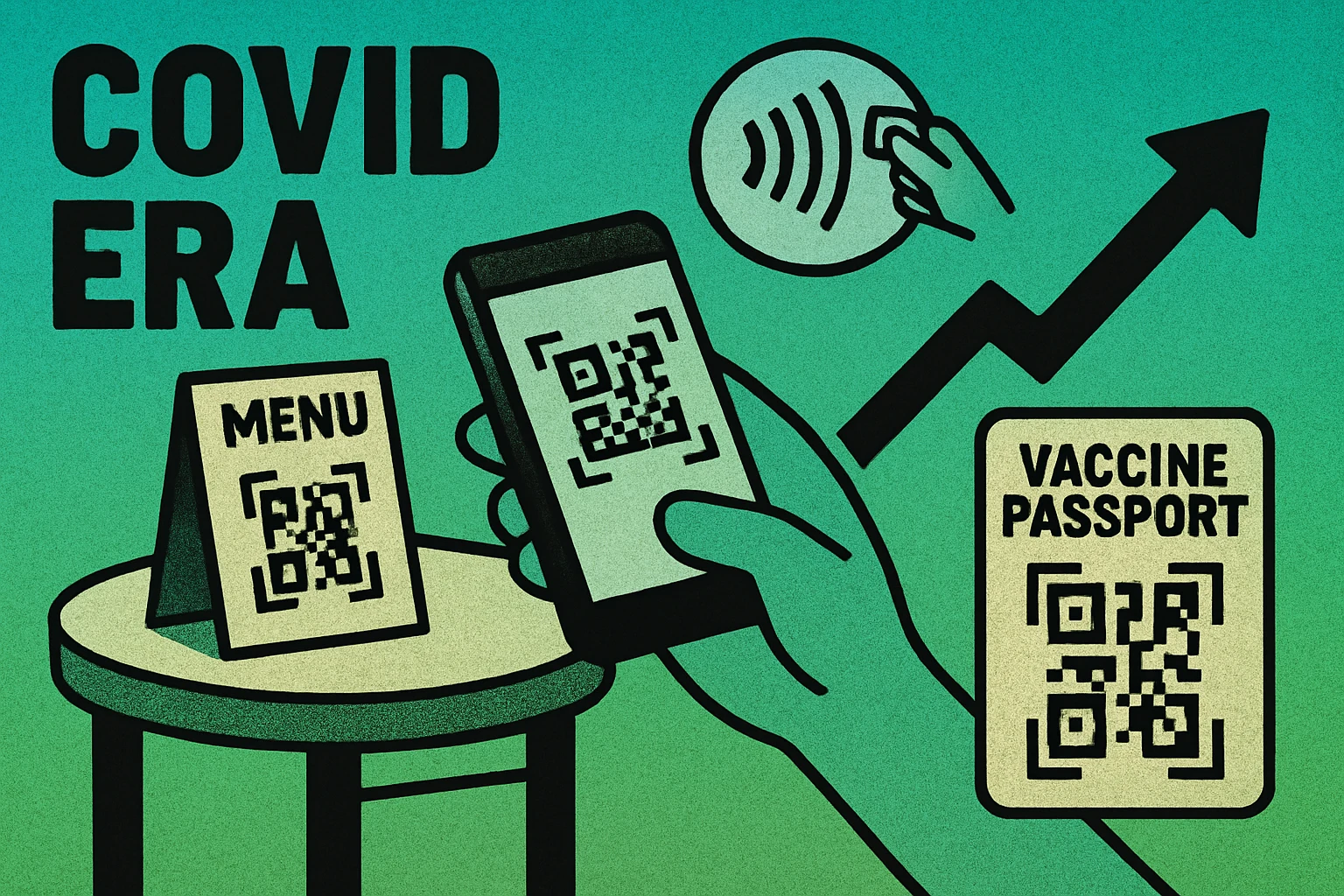
QR code scans increased by 433% between 2019 and 2021 in the United States alone, according to Statista. In Europe, the EU Digital COVID Certificate system processed over 2.3 billion QR-based certificates across 48 countries. The pandemic compressed a decade of adoption into 18 months.
What made the pandemic adoption stick — rather than fading when lockdowns ended — was that both consumers and businesses realized QR codes were genuinely useful. Restaurants discovered that digital menus were easier to update. Consumers found that scanning a code was faster than typing a URL. The behavior became habitual, and habits outlast the circumstances that created them.
QR Code Apps for Mac & Safari
Prefer generating codes without opening a browser tab? These two native Apple apps cover both habits — a full generator on the desktop, and a one-click share button inside Safari.

QR Codes Today (2024–2026)
The history of QR codes is no longer a story about a factory tool or a pandemic workaround. QR codes have evolved into a foundational layer of digital interaction. Here is where they stand in 2026:
Payments
QR-based payment systems now operate in over 40 countries. Brazil's Pix, India's UPI, China's WeChat/Alipay ecosystem, and new systems across Africa and Southeast Asia all rely on QR codes as the primary interface. In Europe, the European Payments Initiative (EPI) is building a unified QR payment standard to work across the eurozone.
EU Digital Product Passport
Starting in 2027, the European Union will require Digital Product Passports for textiles, electronics, and batteries. Each product will carry a QR code linking to a standardized dataset covering materials, supply chain, repairability, and recycling instructions. This is the largest regulatory mandate for QR codes in history and will affect every manufacturer selling into the EU market.
Marketing and Advertising
QR codes on print ads, packaging, and out-of-home advertising now routinely achieve scan rates of 3–8%, compared to click-through rates of 0.5–1% for digital display ads. Super Bowl advertisers, luxury brands, and CPG companies all use QR codes to bridge offline and online experiences. For practical advice on using QR codes in campaigns, see our guide on the differences between static and dynamic QR codes.
Authentication and Identity
QR codes power two-factor authentication (2FA) setup for services like Google, Microsoft, and most banks. Digital boarding passes, event tickets, and loyalty programs all use QR codes as the primary credential format. The technology has become the default way to move a trusted identity from one device or context to another.
QR Code History: A Visual Timeline
Three decades of milestones, from a factory floor in Aichi Prefecture to every smartphone on Earth:
Denso Wave Invents the QR Code
Masahiro Hara and his team create the QR code to track automotive parts at Toyota factories. The two-dimensional matrix can hold 100x more data than a barcode and scans in any direction.
ISO Standard & Open Access
QR codes become an international standard (ISO/IEC 18004). Denso Wave declares the patent royalty-free, allowing anyone to use the technology without licensing fees.
First Camera Phone with QR Scanner
Sharp releases the J-SH09 in Japan with a built-in QR reader. Japanese carriers integrate QR scanning into mobile software, giving consumers direct access for the first time.
Smartphones Go Global
The iPhone and Android era brings QR codes to Western markets. Adoption is slow due to the need for third-party apps, but WeChat Pay and Alipay begin building QR-based payment infrastructure in China.
Apple Adds Native QR Scanning to iOS 11
The iPhone camera app can now read QR codes without any third-party software. Google follows with Android support. The friction barrier disappears for billions of users.
COVID-19 Makes QR Codes Essential
Contactless menus, digital health passes, and vaccination certificates drive a 433% surge in QR scans. The EU Digital COVID Certificate system processes 2.3 billion QR-based certificates across 48 countries.
QR Codes Become Infrastructure
QR-based payments operate in 40+ countries. The EU announces Digital Product Passports requiring QR codes on products by 2027. QR codes are no longer a trend — they are a permanent layer of how the physical and digital worlds connect.
What's Next for QR Codes?
The history of QR codes is still being written. Several trends are shaping where the technology goes from here:
Augmented reality integration. AR platforms are increasingly using QR codes as spatial anchors — scan a code to trigger a 3D overlay on a product, building, or museum exhibit. Apple's Vision Pro and Google's ARCore both support QR-initiated AR experiences.
Supply chain transparency. Beyond the EU Digital Product Passport, companies are voluntarily adding QR codes to products that link to full provenance data: where materials were sourced, how workers were treated, and what the carbon footprint of the product is. Consumers increasingly expect this level of transparency.
Offline-to-online identity. QR codes are becoming the standard way to move identity and credentials between devices. Apple and Google use QR codes for device setup and migration. Passkeys — the replacement for passwords — use QR codes for cross-device authentication.
Customization and branding. Advances in error correction and design tooling mean QR codes no longer need to be black-and-white grids. Branded QR codes with logos, colors, and custom shapes are becoming standard in advertising. The underlying technology is the same — the presentation is evolving. If you want to learn how QR codes handle damage and customization, our complete QR code guide explains error correction levels in depth.
Masahiro Hara's invention solved a specific problem on a specific production line in 1994. Three decades later, it connects billions of people to information, payments, and services every day. The history of QR codes is a case study in how open standards, good timing, and genuine utility can turn a niche industrial tool into global infrastructure.
Frequently Asked Questions
QR codes were invented in 1994 by Masahiro Hara and his team at Denso Wave, a subsidiary of the Toyota Group. They were originally designed to track automotive parts during manufacturing, replacing slower one-dimensional barcodes.
QR stands for Quick Response. The name reflects the code's primary design goal — to be decoded quickly by scanners on fast-moving production lines. A QR code can be read roughly ten times faster than a traditional barcode.
Denso Wave chose not to enforce its patent rights on the QR code standard. While it still holds the patent, it declared the technology royalty-free, allowing anyone to generate, print, and scan QR codes without licensing fees. This open-standard decision is the single biggest reason QR codes became ubiquitous.
QR codes gained mainstream global traction around 2010–2012, when smartphones with built-in cameras became widespread. However, they truly exploded during the COVID-19 pandemic in 2020, when contactless interactions made QR codes essential for menus, check-ins, vaccination records, and payments worldwide.