Why QR Code Generator Features Actually Matter
Most people discover a QR code tool when they need one urgently — a product launch, a print deadline, an event tomorrow. They grab the first result from a search, use the free tier, and move on. That's fine for a one-off use. But if you generate QR codes with any regularity, the feature set of your chosen tool shapes every output you produce: its visual quality, its scanability, its compatibility with your print workflow, and whether your data stays private.
The QR code generator market is crowded. There are web tools, browser extensions, desktop apps, mobile apps, and SaaS platforms, all claiming to offer "the best" experience. In practice, the differences between them are significant. Some export only low-resolution PNG with no branding options. Others lock the features you actually need behind monthly subscriptions. A few rare tools — typically native desktop applications — offer the full feature set for a single purchase.
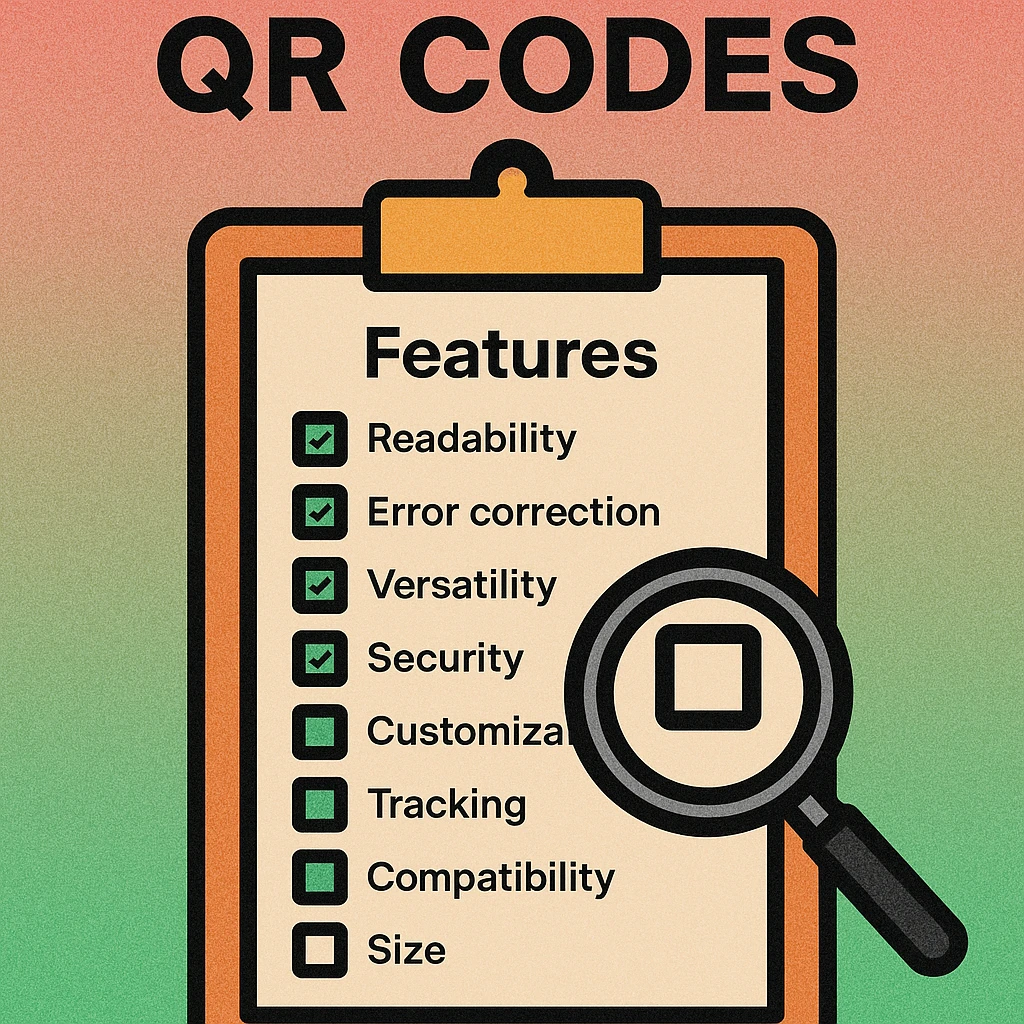
This checklist is an evaluation framework. Use it before you commit to any tool, whether you're choosing for yourself, recommending a tool to a client, or building a QR code workflow into a larger process. Each of the ten features below is scored on a simple three-point scale: Full (included without restrictions), Partial (available but limited or behind a paywall), or Missing (not supported).
For context on how different tools compare at a high level, see our detailed QR code generator comparison. If pricing is your primary concern, the free vs paid QR code generator guide covers the trade-offs in depth. This article focuses specifically on the features themselves — what they are, why they matter, and how to evaluate them.
For each feature, note whether the tool you're evaluating scores Full, Partial, or Missing. A professional-grade tool should score Full on features 1–5. Features 6–10 are strong differentiators that separate good tools from great ones.
Must-Have Features: Numbers 1–5
These five features are non-negotiable for anyone producing QR codes for professional use. A tool that scores Partial or Missing on any of these will create friction at exactly the wrong moment — typically when you're on a deadline.
Feature 1: Custom Colours and Branding
A QR code does not have to be black and white. The QR specification supports any high-contrast colour combination, and a good generator lets you set foreground and background colours independently using hex values or a colour picker. This matters because branded QR codes — those using your brand palette — perform measurably better in real-world placement. They integrate naturally with packaging, signage, and printed materials rather than looking like an afterthought.
What to look for: the ability to set foreground (module) colour and background colour separately, with full hex or RGB control. Bonus points for being able to set gradient fills or per-eye colours. Avoid tools that only offer a fixed set of colour presets without hex input — you'll rarely have a preset that matches your brand exactly.
For a deeper exploration of design options, see our guide to branded QR codes with logos. The design principles for colour apply equally whether or not you're adding a logo. The key rule is maintaining sufficient contrast (at minimum 4.5:1) so that scanner algorithms can reliably detect the code — which is why pastel-on-white combinations should always be tested before going to print.
Custom colour control is essential for professional output. A tool that forces black-and-white codes limits your branding options and requires workarounds in design software.
Feature 2: Logo Embedding
Embedding a logo at the centre of a QR code is one of the most effective ways to reinforce brand recognition at the point of scan. It works because the QR specification includes error correction capacity: even with a portion of the pattern obscured, the code remains scannable. At error correction level H (30% data recovery), there is ample space to place a logo covering up to roughly 25–30% of the code area.
What to look for: the ability to import your own image file (PNG with transparency preferred), control over logo size relative to the QR code, and automatic error correction adjustment to compensate for the obscured area. Avoid tools that only allow their own watermark logo rather than your custom image — this is a common limitation on free tiers and actively harms your branding rather than helping it.
Also check for padding or a white halo around the logo. Without a small margin between the logo and the surrounding QR modules, scanning reliability decreases because modules near the logo boundary become ambiguous. A well-designed generator adds this padding automatically.
Feature 3: SVG / Vector Export
This is arguably the single most important technical feature for anyone who works with print. A QR code exported as a PNG at 1000×1000 pixels looks fine on a web page and a small printed card. Scale it to an A1 poster or a trade show banner and it becomes visibly pixelated. An SVG export is mathematically scalable to any size — from a 1-inch product label to a 20-foot billboard — with no quality loss whatsoever.
SVG files are also easier to work with in professional design tools like Adobe Illustrator, Affinity Designer, and Figma. You can open an SVG, adjust colours, add to layouts, and export directly to PDF for press without any intermediate rasterisation step. For a complete overview of format options and when to use each, see our dedicated guide to QR code file formats.
What to look for: SVG export as a standard (not premium) feature. Be cautious of tools that advertise "vector export" but actually export an SVG file containing an embedded raster image — this is a common pattern that defeats the purpose. Open the SVG in a text editor and check that the file contains <path> or <rect> elements rather than a <image> tag pointing to a base64-encoded PNG.
SVG export is non-negotiable for print work. If the tool only exports PNG, you will encounter quality problems the first time you need a large-format output.
Feature 4: Offline Capability
Web-based QR code generators are convenient for occasional use, but they introduce a dependency that can derail your workflow at the worst moment: they require an active internet connection. If you're setting up signage at a venue with poor Wi-Fi, generating codes at a trade show, or working on a client site with firewall restrictions, a web tool may simply be unavailable when you need it most.
A native desktop application — particularly a macOS app installed from the Mac App Store — runs entirely on your device. It generates QR codes using local processing, stores no data remotely, and works identically whether you're connected to gigabit fibre or sitting in an airplane with flight mode on. The practical reliability difference between a native app and a web tool is easy to underestimate until the moment it matters.
Offline capability also has a privacy dimension. When a web tool generates your QR code, the data you encode — your URL, Wi-Fi password, contact information — is transmitted to and processed on a third-party server. For most URLs this is inconsequential, but for Wi-Fi credentials, private API endpoints, or sensitive contact data, server-side processing represents a genuine data handling concern. An offline, on-device tool eliminates this exposure entirely.
Feature 5: Multiple QR Code Types
A QR code is not just a link. The standard supports a rich variety of data types, each with specific encoding conventions that scanners know how to handle. A URL QR code, when scanned, opens a browser. A Wi-Fi QR code, when scanned on iOS or Android, prompts the device to join that network directly — no password entry required. A vCard QR code, when scanned, offers to add a contact to your address book. Each type has its own syntax, and a good generator encodes each one correctly rather than forcing you to manually format data strings.
Minimum type coverage for a professional tool: URL, plain text, Wi-Fi (with SSID, password, and encryption type fields), vCard contact, email, SMS, phone, and calendar event. Extended type coverage that's increasingly useful: app store links (iOS / Android), geo-coordinates, cryptocurrency addresses, and SEPA payment data.
When evaluating a tool, open a browser tab and try to create a Wi-Fi QR code. If the tool only gives you a text field rather than structured SSID/password/encryption inputs, it doesn't properly support the Wi-Fi type — and the same under-engineering may apply to other types.
High-Value Features: Numbers 6–10
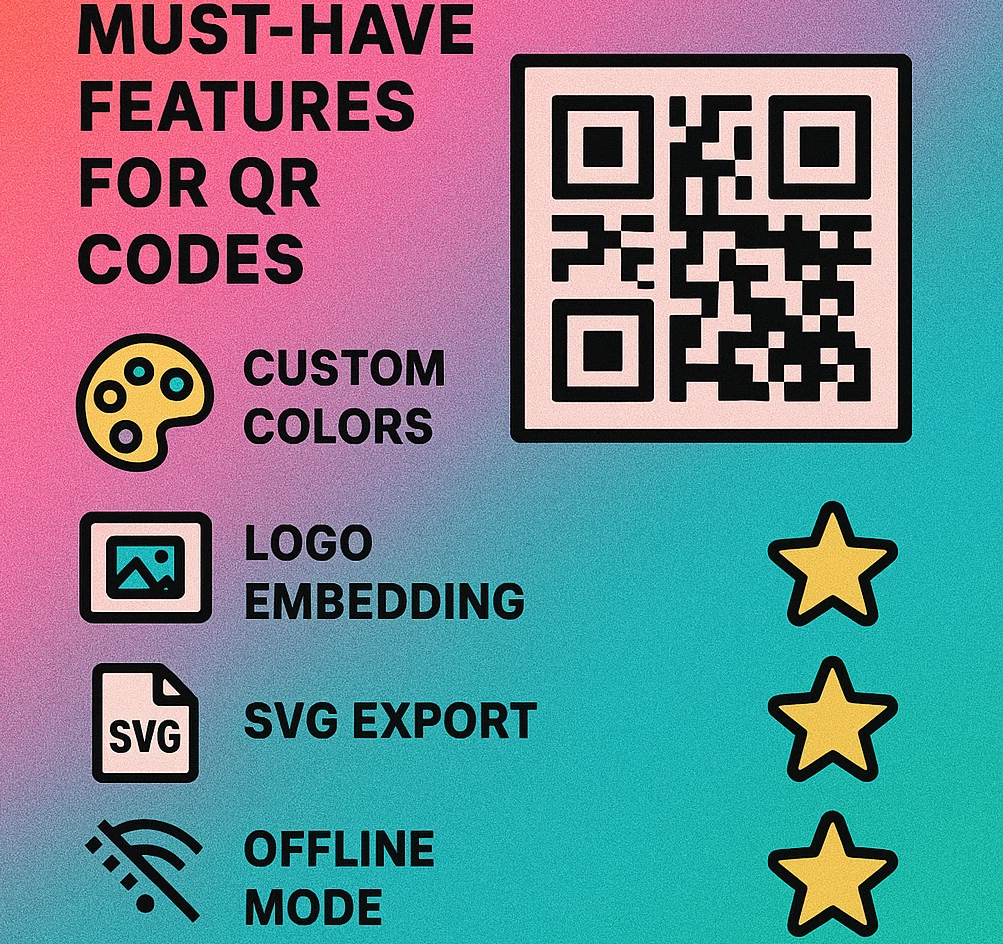
These five features are not universally required, but they separate a good tool from a great one. For power users, agencies, and anyone with a serious QR code workflow, these features significantly affect productivity and output quality.
Feature 6: Error Correction Control
Error correction is one of the least-discussed but most important QR code parameters. The QR standard defines four error correction levels: L (7% data recovery), M (15%), Q (25%), and H (30%). The choice of level affects two things simultaneously: how much of the code can be damaged or obscured before it fails to scan, and how dense and visually complex the code's pattern is.
Higher correction levels add more redundant data to the QR pattern, which makes the code larger (more modules) for the same payload. This density can look visually busy and may scan less reliably in low light or at an angle. Lower correction levels produce cleaner, sparser patterns that scan easily in ideal conditions but are more vulnerable to physical damage or obstruction.
The practical implication: always use level H when embedding a logo. The logo obscures a portion of the code, and level H provides enough redundancy to recover that lost data. For codes that will appear outdoors, on weathered packaging, or in physically demanding environments, use level M or Q. For pristine digital displays with controlled scanning conditions, level L is acceptable and produces the cleanest-looking result. For a complete technical explanation, see our article on QR code error correction levels.
What to look for: explicit error correction level selection as a UI control — not hidden in "advanced settings" but readily accessible. Some tools silently override your chosen level when you add a logo (usually raising it to H automatically), which is helpful but should be communicated transparently.
Feature 7: Bulk Generation
If you routinely generate more than a handful of QR codes, the ability to create them in batches from a data file is a significant time saver. Bulk generation typically works by importing a CSV with multiple rows of data — each row producing one QR code — and exporting a corresponding set of files, optionally named after a field in the input data.
This feature is essential for use cases like product labelling (each SKU gets a unique code), event ticketing (each attendee gets a unique check-in URL), or multi-location signage (each venue page gets its own code). Doing this manually, one code at a time, is feasible for five codes and agonising for fifty.
What to look for: CSV import with column mapping (which column is the URL, which is the filename), batch export to a folder, and consistent styling across all generated codes. Some tools support batch with consistent design but require you to process each row in sequence — that's meaningfully different from true one-click batch export, so clarify this before relying on the feature for large volumes.
Feature 8: Privacy and On-Device Processing
As touched on under offline capability, the question of where QR code processing happens is not merely a performance consideration — it's a data governance one. When you encode a URL, the URL itself may be unremarkable. But QR codes are also used to encode Wi-Fi passwords, private staging server addresses, internal intranet URLs, contact details, and authentication tokens. For any of these use cases, sending the encoded data to an external server introduces a point of potential exposure.
On-device processing means the generator runs as local code on your machine. Nothing is transmitted. Nothing is logged. The QR code is generated using a local algorithm, and the resulting image is written directly to your storage. This is the default behaviour for any properly built native desktop application and is categorically different from a web tool that must submit your data to a backend API to produce the image.
What to look for: a clear statement from the developer that generation is performed on-device with no data transmission. For native Mac or Windows apps, this is typically verifiable by running the tool in airplane mode — if it still generates codes, it's processing locally. For web tools, on-device generation requires the tool to use a client-side JavaScript QR library; some do, but this should be confirmed in the tool's documentation rather than assumed.
On-device processing matters most when encoding sensitive data. For Wi-Fi passwords, private URLs, and contact details, a tool that never transmits your data is always the safer choice.
Feature 9: Print-Ready Output
Generating a scannable QR code and generating a print-ready QR code are related but distinct outcomes. A scannable code can be a 300px PNG. A print-ready code meets the technical specifications required by professional print workflows: minimum resolution (typically 300 DPI for the final output size), correct colour space (CMYK or RGB depending on print process), adequate quiet zone, and an export format that preserves all of these properties through the print production chain.
The quiet zone — the white margin surrounding the QR code pattern — is particularly important and often underestimated. The QR specification requires a quiet zone of at least four modules wide on all sides. Many generators crop this zone incorrectly or omit it entirely when you request a tight crop. If your QR code is placed against a coloured background without this margin, it may scan unreliably or fail entirely on certain scanner implementations.
What to look for: export resolution control (the ability to set DPI or pixel dimensions), quiet zone control (the ability to specify or verify the margin size), and ideally a PDF export option for direct placement into InDesign, Quark, or Canva print workflows. SVG export with correct proportions also qualifies, since SVG files are inherently resolution-independent and preserve quiet zone geometry precisely.
Feature 10: No Subscription Pricing
The final item on this checklist is not a technical feature but a business model criterion — and it arguably matters as much as any of the nine features above. Subscription-priced QR code tools create a perpetual financial obligation for a capability that does not become more complex over time. The QR standard is stable. The algorithm that generates a QR code is the same in 2026 as it was in 2010. Paying monthly for that algorithm is paying for cloud infrastructure, support overhead, and vendor margin, not for ongoing feature development that benefits you.
A one-time purchase tool, by contrast, aligns the vendor's incentive with yours: they build a capable product, you buy it once, and you use it indefinitely. For a detailed financial analysis of this trade-off, see our article on QR code generators with no subscription. The short version: at typical subscription pricing of $5–15/month, a one-time purchase app breaks even in two to three months and saves significant money in every subsequent period of use.
The no-subscription model also eliminates the risk of feature degradation. Subscription tools can and do reduce their free tier capabilities over time, raise prices at renewal, or sunset features with limited notice. A purchased-once application maintains its feature set indefinitely, with updates delivered as improvements rather than leverage for price increases.
QR Code Apps for Mac & Safari
Prefer generating codes without opening a browser tab? These two native Apple apps cover both habits — a full generator on the desktop, and a one-click share button inside Safari.
The Scoring Rubric: How to Rate Any Tool
Use this framework to score any QR code generator you're evaluating. Assign each feature a score of 2 (Full), 1 (Partial), or 0 (Missing). A tool's maximum possible score is 20. Professional-grade tools should score 16 or higher. Any tool scoring below 10 should be considered insufficient for regular professional use.
| # | Feature | Full (2 pts) | Partial (1 pt) | Missing (0 pts) |
|---|---|---|---|---|
| 1 | Custom colours & branding | Full hex control, no restrictions | Preset colours only | Black & white only |
| 2 | Logo embedding | Custom image, size control, auto EC | Logo supported, limited control | Not supported |
| 3 | SVG / vector export | True vector SVG, no paywall | SVG behind paywall or raster-in-SVG | PNG only |
| 4 | Offline capability | Fully offline, on-device processing | Partial offline (some features need net) | Always online required |
| 5 | Multiple QR types | 8+ types with structured input | 3–7 types or generic text fields | URL only |
| 6 | Error correction control | L / M / Q / H selectable | One or two levels, no full control | Fixed level, no control |
| 7 | Bulk generation | CSV import, batch export, styled | Batch supported, limited styling | One at a time only |
| 8 | Privacy / on-device processing | All processing local, no transmission | Partial local processing | All processing server-side |
| 9 | Print-ready output | High DPI, quiet zone, PDF/SVG export | High DPI PNG but no vector | Low-res only |
| 10 | No subscription pricing | One-time purchase, all features | Free tier or one-time with limits | Subscription required for full features |
Gen QR — QR Code Maker: Full Scorecard
Applying this checklist to Gen QR — QR Code Maker, the native Mac App Store application available at apps.apple.com, yields the following results. See also the comprehensive QR code generator for Mac guide for a broader context of the Mac landscape.
Gen QR Feature-by-Feature Assessment
Custom colours & branding — Full (2/2). Gen QR offers complete foreground and background colour control via hex input. You can match any brand palette precisely, and the preview updates in real time so you can verify contrast before exporting.
Logo embedding — Full (2/2). Import any PNG, JPEG, or SVG as a centre logo. Logo size is adjustable, and the app automatically increases error correction to level H when a logo is active to maintain scan reliability.
SVG / vector export — Full (2/2). SVG export is a standard feature, not a paid add-on. The exported SVG contains true vector path elements — no embedded rasters — and scales perfectly to any output size. High-resolution PNG is also available for workflows that require it.
Offline capability — Full (2/2). As a native macOS application, Gen QR runs entirely on-device. QR code generation requires no network connection. The app functions identically in flight mode, on isolated networks, or on machines without internet access.
Multiple QR types — Full (2/2). Gen QR supports URL, plain text, Wi-Fi, vCard contact, email, SMS, phone, and calendar event, with structured input forms for each type — no manual data string formatting required.
Error correction control — Full (2/2). All four error correction levels (L, M, Q, H) are selectable. The app automatically switches to level H when a logo is present and communicates this clearly in the UI.
Bulk generation — Full (2/2). CSV import with column mapping enables batch generation of styled QR codes. All design settings (colour, logo, correction level, format) apply consistently across the entire batch.
Privacy / on-device processing — Full (2/2). Generation is entirely local. No data leaves your device. There is no backend API, no account, and no data retention — because there is no server to retain it on.
Print-ready output — Full (2/2). SVG export with correct quiet zone geometry, plus high-resolution PNG at user-specified dimensions. Exported files import directly into professional print workflows without additional processing.
No subscription pricing — Full (2/2). Gen QR is a one-time purchase from the Mac App Store. All features listed above are included in the purchase price, with no recurring fees, no feature tiers, and no expiry. For the pricing case in detail, see the guide on no-subscription QR code generators.
Gen QR — QR Code Maker: 20/20. The only tool evaluated in our research to score Full on all ten checklist criteria. Available as a one-time purchase on the Mac App Store.
The Only QR Generator That Checks Every Box
Gen QR — QR Code Maker for Mac. Custom colours, logo embedding, true SVG export, offline processing, 8+ QR types, error correction control, bulk generation, full privacy, print-ready output, and a one-time purchase price. No subscription. No compromises.
How to Evaluate Any QR Code Tool Before Committing
Armed with the 10-point checklist and scoring rubric above, here is a practical evaluation process for any tool you're considering. This takes approximately 15 minutes and will tell you everything you need to know before committing to a purchase or workflow dependency.
15-Minute Evaluation Protocol
Test the export first. Before evaluating anything else, generate a simple URL QR code and download or export it. Check whether SVG export is available and whether the resulting file is a true vector. This single test eliminates tools with a critical gap in under two minutes.
Try a Wi-Fi QR code. Navigate to the Wi-Fi QR type and confirm it provides structured fields for SSID, password, and encryption type. If it gives you a plain text field with a hint like "enter your Wi-Fi data as a string," the type support is superficial and other types are likely similarly under-engineered.
Add a logo and check error correction. Upload a PNG logo and observe: does the tool automatically raise error correction to level H? Does the QR code remain scannable with the logo in place? Use your phone's camera to verify. If the code won't scan, the tool's logo implementation is broken regardless of how it looks.
Test offline or in flight mode. For native apps, switch to flight mode and attempt to generate a code. For web tools, check whether the page uses a client-side library by opening browser developer tools and watching for network requests during generation. A request to an external API during QR generation means your data is leaving your device.
Read the pricing page carefully. Does the tool offer all features you need on a one-time purchase? Which features are gated behind higher subscription tiers? Calculate the annual cost at the tier level you would actually need, and compare it to a one-time purchase alternative. The math rarely favours the subscription for individual users.
The evaluation process above is calibrated for efficiency: it focuses on the features most likely to be missing or restricted on lower-quality tools. If a tool passes all five checks in 15 minutes, it's worth deeper evaluation. If it fails on step 1 or step 2, move on immediately — the remaining features are unlikely to compensate for a foundational gap.
For a specific side-by-side comparison of popular tools using criteria related to this checklist, see our QR code generator comparison. For the pricing angle specifically — which tools offer genuine one-time purchase models versus which reframe subscriptions as "lifetime access" — the free vs paid guide covers the landscape with specific examples.
For Mac users who need professional-grade QR code generation without a recurring subscription, Gen QR — QR Code Maker is the most complete tool available in the App Store. It is the only tool we have evaluated that scores Full on all ten checklist criteria, available at a single purchase price that breaks even against competing subscriptions within months. See our detailed review within the Mac QR code generator guide for a full walkthrough of its interface and workflow.
Frequently Asked Questions
SVG or vector export is arguably the most important feature for professional use because it means your QR code scales to any size — from a business card to a billboard — without pixelation. If a generator only exports raster PNG at a fixed resolution, you will hit quality limits the moment you need large-format print output. Custom branding and offline capability follow closely in importance.
It depends on your use case. If you work from a fixed office with reliable internet, an online tool may be fine. However, for anyone who creates QR codes at trade shows, client sites, remote locations, or on travel, offline capability is essential. A native desktop app that processes everything on-device gives you guaranteed availability regardless of connectivity, and also means your data never leaves your machine.
Error correction determines how much of the QR code pattern can be damaged or obscured before the code becomes unscannable. Higher error correction (level H, 30% recovery) is essential when you add a logo to the centre of a QR code, or when codes will be used outdoors where smudging, weathering, or partial obstruction is likely. Lower correction (level L, 7% recovery) produces a less dense, cleaner-looking code for pristine digital use. Being able to choose the level gives you control over the trade-off between resilience and visual density.
A well-rounded generator should support at least: URL, plain text, Wi-Fi credentials (SSID, password, encryption type), vCard/contact, email, SMS, phone number, and calendar event (vEvent). Specialised types like geo-coordinates, app store deep links, and cryptocurrency addresses are useful additions. The more types supported natively, the less manual encoding work you have to do.
For most individual users and small businesses, no. Subscription tools make sense when you need dynamic QR codes with redirect editing, centralised team management, or scan analytics dashboards. For static QR code generation with full branding and export quality, a one-time purchase native app delivers the same output at a fraction of the lifetime cost — typically breaking even within three months compared to a monthly subscription.